USAID. MISSION TO LIBERIA
Liberia impact study : agriculture program development
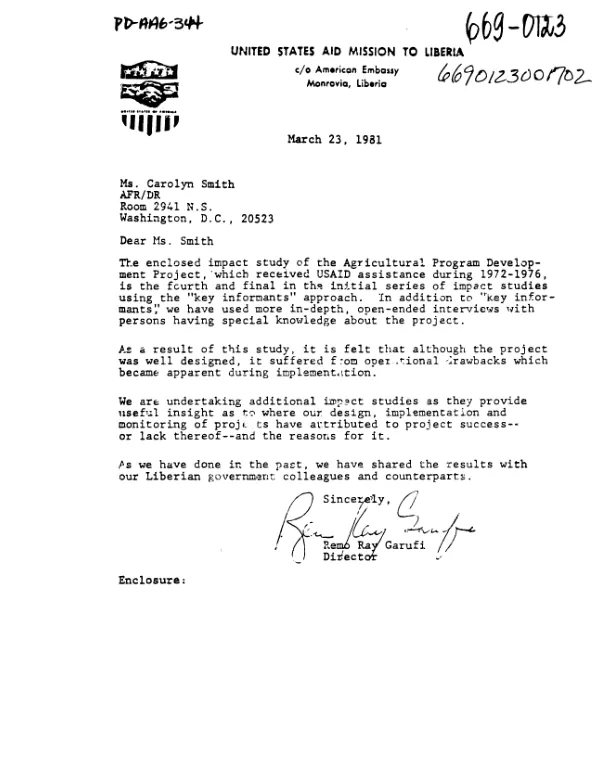
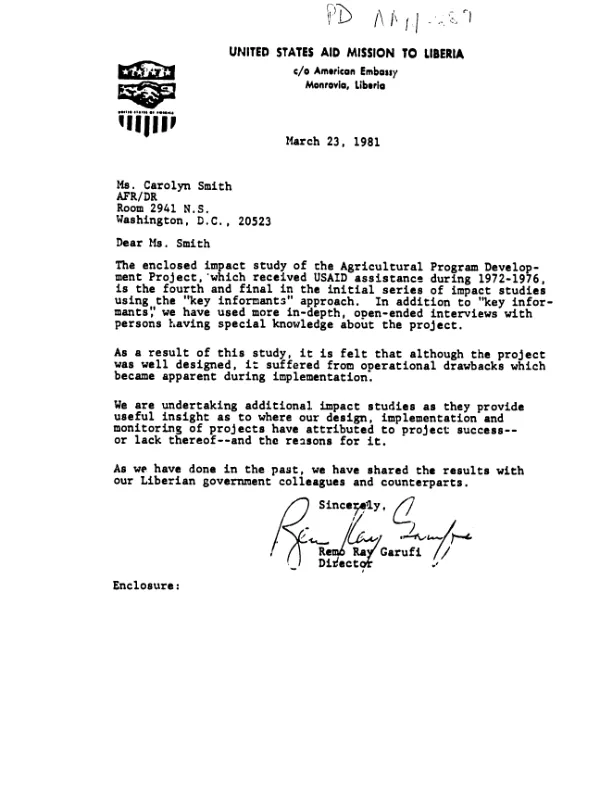
Evaluates project to strengthen planning and management within Liberia's Ministry of Agriculture (MOA).
1980
Sign in to readA free account is required to download.
Abstract
Ex post evaluation covers the period 1972-76 and is based on document review and interviews with persons having special knowledge of the project. Although the project attempted to address fundamental problems within the MOA, its impact was severely limited due to political and organizational constraints. The MOA was unable to provide a framework for planning and managing a sound agricultural program. Within the Ministry, individual, uncoordinated projects developed their own vested interests and ad hoc implementation arrangements inevitably evolved. Neither research nor extension policies were developed, efforts in these areas were not coordinated, and training needs inventories were never conducted for either the MOA or the overall agricultural sector. Project training was beneficial, but not always exactly as planned. Of 35 MOA participants, 23 completed Master's degrees (mostly in Agricultural Economics and Statistics), 7 attended short courses, 2 completed diploma courses, and 3 attended conferences abroad. As a result, the MOA's Statistical Division became operational (but two subsequent Ministers ignored its contributions) and a Planning Bureau was created. The latter, initially well staffed and operated, was vitiated as most staff with postgraduate training left the MOA when A.I.D. and World Bank in 1976 inadvertently undercut sectoral planning by focusing on integrated rural development. A few have returned to top MOA positions where, overburdened with administrative duties, they are unable to perform the job for which they were trained. Moreover, abuses in the soil science component by supervisors and politicians led to the departure of contracted soil scientists; a marketing system was not established within the MOA because the Minister staffed the Marketing Sections with incompetent persons (family and political connections); no technology transfer function was developed, partly because no technology existed to be transferred and partly because of meager MOA resources. In brief, the project, while well-designed, suffered from misguided optimism about MOA resources (leadership, manpower, funds) and the Liberian work ethic.
Related documents