USAID DEC
Life cycle health education project in West Bank, Jerusalem, and Gaza -- mid-project evaluation
Sign inUSAID. BUR. FOR ASIA AND NEAR EAST
Life cycle health education project in West Bank, Jerusalem, and Gaza -- mid-project evaluation
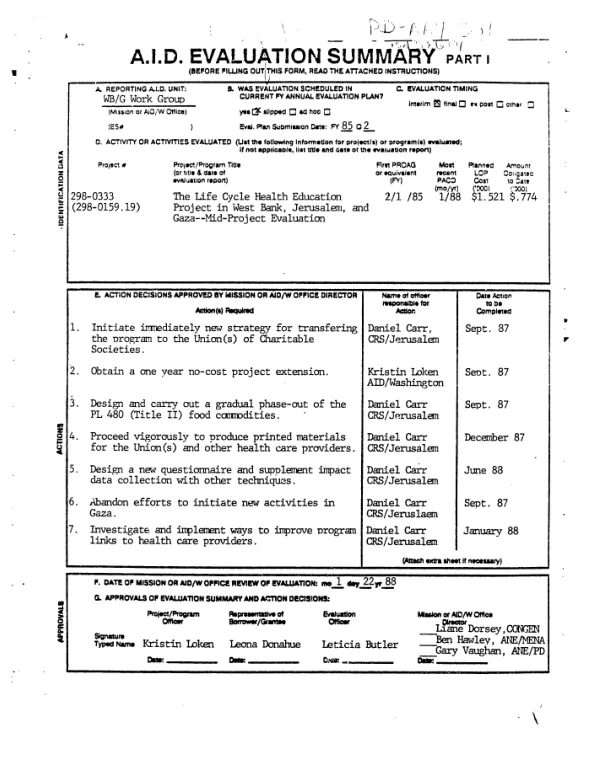
Summarizes interim evaluation (PD-AAW-935) of a Catholic Relief Services project to improve the health status of Palestinian mothers and their children in the West Bank and Gaza through preventive health education.
1988
Sign in to readA free account is required to download.
Abstract
The evaluation covers the period 2/85-3/87. The project, as implemented on the West Bank, may be one of A.I.D."s most successful primary health care (PHC) efforts anywhere, especially in terms of impact on women. It by far the most extensive PHC initiative on the West Bank. Most quantitative training and teaching targets have been met already or will be met before the end of the project. The quality of the efforts and the new knowledge they offer to thousands of village mothers throughout the West Bank are widely admired by everyone familiar with the project. However, no firm data exist for measuring the impact of these efforts on health status. Unfortunately, little progress has been made in institutionalizing the project, largely because of financial and political constraints facing Palestinian organizations. The Union of Charitable Societies (UCS) in Nablus has just recently agreed to take over the program in the northern region of the West Bank. The organization appears to have the will to sustain the project, although it lacks the means. In Gaza, objectives have not been achieved, but for several reasons this should not be considered a major failure. While the West Bank program had already been established at the outset of the project, operations in Gaza began from scratch. Gaza"s population - primarily refugees - is also far less capable of implementing the project than are the West Bank charitable societies. One successful 6-month health education course was conducted for young women in Gaza, but further activities are not planned. Two major lessons were learned. (1) The time frame for a project involving behavioral change must be longer than 3 years. The success of this program is the result of decade-long persistence in eliciting community participation and improving services - not of effective project design. (2) Salaries set above local levels will impede efforts to sustain programs locally. Action decisions are to: (1) initiate a new strategy for transfering the program to UCS; (2) obtain a 1-year no-cost project extension; (3) gradually phase out the use of P.L. 480 Title II commodities; (4) produce printed materials for the UCS and other health care providers; (5) design a new questionnaire and supplement impact data collection with other techniques; (6) abandon efforts to initiate new activities in Gaza; and (7) investigate and implement new ways to improve program links to health care providers.