CATHOLIC RELIEF SERVICES (CRS)
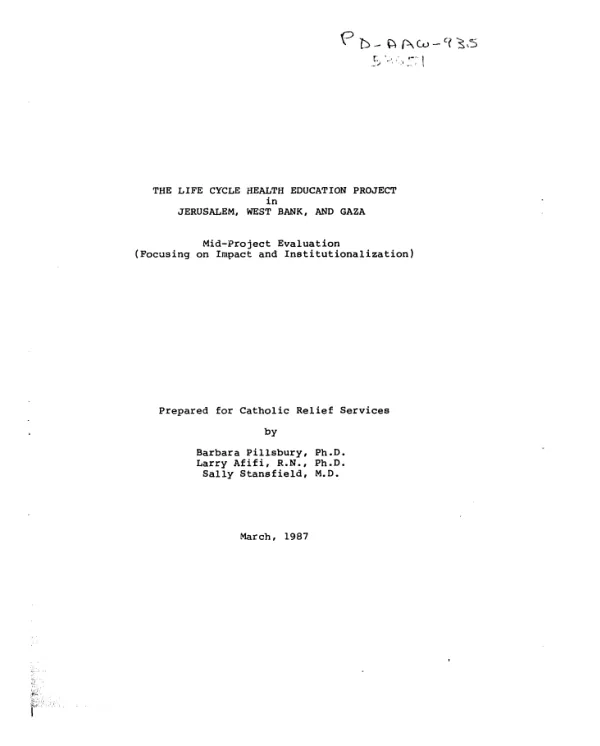
Life cycle health education project in West Bank : mid-project evaluation
Mid-term evaluation of a project to provide village-level health education and home-based rehabilitative services in the West Bank.
Sanber, Shukri · 1989
Sign in to readA free account is required to download.
Abstract
Catholic Relief Services (CRS) is the implementing agency. The evaluation covers the period 1988-12/89. The project operates about 156 village programs throughout the West Bank, with a trained health education worker posted at each center. Project administration has been successfully transferred to six regional societies. In the past year, these societies have increased their training capacity by organizing four training sessions for new health workers. While the basic curriculum has not been changed since 1985, additional materials have been produced and provided to teachers for optional use. The process of combining the project's rehabilitation and health education components is generally progressing as planned. About 47 handicapped children are visited weekly by village workers, and 30 more workers are scheduled for rehabilitation training. Upon graduation, they will add home-based rehabilitation work to their health education activities. The new management of the project, which is headed by a Palestinian psychologist, is functioning successfully. The project is also characterized by several weaknesses, however. Health workers have had difficulty attracting mothers to the program or retaining them therein, apparently due in part to the workers' poor teaching skills. As a result, some workers have resorted to using food aid as an incentive for mothers to participate in health education activities, despite CRS directions to provide food to all needy families, including those who do not participate in the program. While CRS organized several in-service workshops to improve teaching skills during 1987 and 1988, none have been offered this year. Although child growth patterns are effectively monitored, the cumulative records of mothers and children are not maintained. No plans have been made for the transfer of financial responsibility to the regional societies, which are expected to cover 10% of health worker salaries by 1990.
Related documents