NAVRONGO HEALTH RESEARCH CENTRE
Light at the beginning of the tunnel
Lessons learned from the Navrongo primary health care pilot project in Ghana are detailed in this report.
2001
Sign in to readA free account is required to download.
Abstract
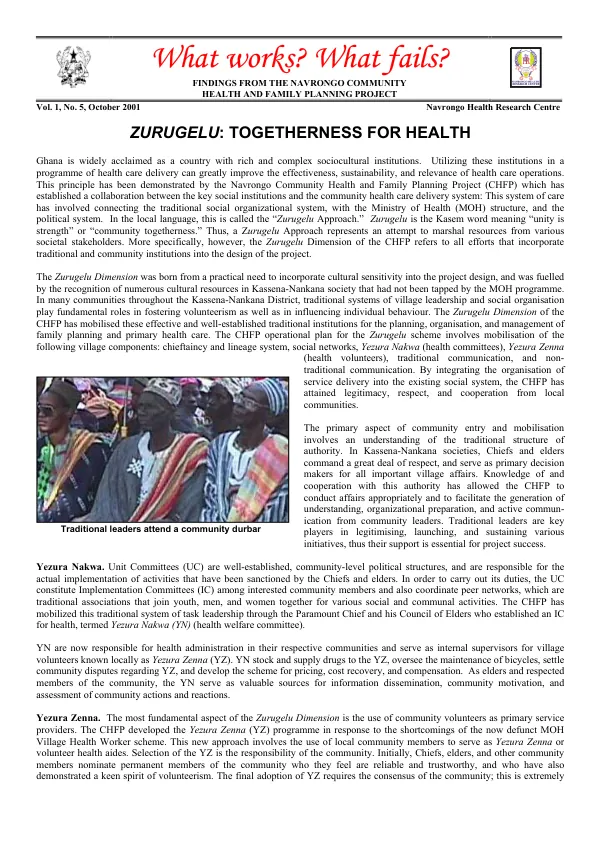
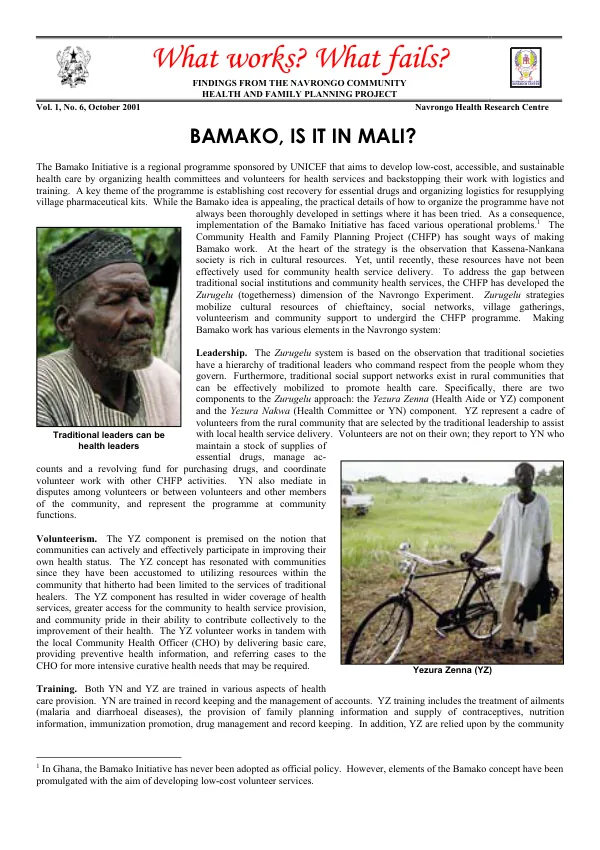
(1) In remote and traditional communities, mobility of women and autonomy to seek health services is extremely limited. To be accessible to all, health care services must be based in the community. This has been achieved by fostering volunteer construction of community health compounds (CHCs) where nurses, termed community health officers (CHOs), live and provide services. (2) When CHCs are placed too close to the chiefs" compounds or when nurses are related to influential families, performance -- especially regarding family planning (FP) services -- is less than if nurses are outsiders. Women prefer female service providers who have no links to the community. (3) When men are recruited as health aides, termed yezura zenna (YZ), they are viewed as community health mobilizers who contact men to discuss and legitimize the program. (4) When services are restructured to reach people and staff of the Ministry of Health (MOH) are redeployed more efficiently, old staffing norms become obsolete and constraining. A nurse living in the community is at people"s beck and call around the clock. By contrast, a subdistrict clinic nurse typically works between 10:00 am and noon. The number of CHOs currently assigned to Kassena-Nankana District is too small for achieving adequate coverage of the communities with the expected quality of service. (5) An interesting finding of the experiment is the willingness of men to discuss FP with the CHOs, who are women. Women can serve quite effectively as information providers to men, so long as strict secrecy about the contraceptive decisions of wives is maintained at all times. Using a male approach that involves meetings with elderly men also helps tremendously to defuse opposition. Men make the decisions in the community, but know very little about FP. Their opposition to FP is therefore based on ignorance. By constituting village elders as health committee members and involving them in public FP discussions, legitimacy and the notion of some level of acquiescence is given to FP and this greatly improves the atmosphere for individual FP decisions. (6) Communities construct CHCs for CHOs to use as their residence and Level A clinic. This is a low-cost program that can be implemented anywhere. However, over- reliance on traditional architecture and building materials can lead to non-sustainable structures. Traditional compounds are built by men through communal labor, but routine maintenance is carried out by women. CHOs are too busy to perform maintenance work on their compounds; roof leaks often develop, causing structural problems. A typical traditionally designed structure as residence for the community-resident nurse is not sustainable. Modest resources from the MOH or other sources should be committed to providing building materials for the CHCs and latrines, in addition to providing some funds for mobilizing community labor to put up the structures. (7) Village work is a new challenge for the CHOs because it requires mechanisms for technical, community, and supervisory support for their work. Frequent practical training sessions are needed to develop community liaison and teamwork. (8) Mechanisms for traditional governance and group action can be utilized for communicating with communities. Liaison with chiefs, elders, and lineage heads, cooperation with village peer networks and group leaders can legitimize and explain FP to men. Chiefs, elders, and community leaders welcome dialogue with the MOH staff and seek regular exchanges. (9) Critically needed preventive health care should be taken to every compound. Health education must be compound-relevant and compound-specific to be relevant to community members. Community members build trust in the health worker and the health service delivery system that they see as responsive to their needs. Under such conditions of mutual trust, acceptance of FP makes sense and opposition to it becomes minimal, even among men. (10) When nurses are deployed to village locations, significant improvements in child health are realized. When zurugelu (community-level) activities are added to the nurse, contraceptive use increases and fertility declines.
Related documents