FHI 360
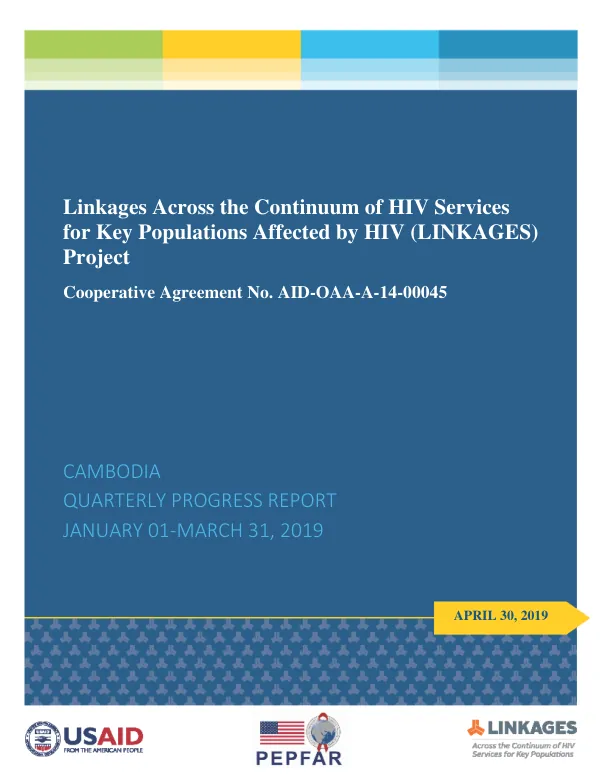
LINKAGES Quarterly Report (January 1-March 31, 2019) - CAMBODIA
The LINKAGES project in Cambodia aims to rapidly scale-up activities to deliver on the HIV continuum of prevention, care, and treatment cascade and realize the UNAIDS 90-90-90 goals by 2020.
2019 · 20 pages
Sign in to readA free account is required to download.
Abstract
During the reporting period, LINKAGES provided technical assistance to the National Center for HIV/AIDS, Dermatology and STD (NCHADS) on four project components, including the Community Action Approach (CAA) and Partner Notification Tracing and Testing (PNTT). The CAA component focused on strengthening case profiling and counseling skills for Community Action Counselors (CAC) and Voluntary Confidential Counselling and Testing (VCCT) counselors. Risk profiling is an ongoing process carried out at health facilities by CAA staff and reported to NCHADS for analysis and program use. The CAA quality assurance and quality improvement checklists were developed, and LINKAGES Provincial Technical Officers (PTOs) conducted field monitoring visits and provided technical assistance to CAA implementers in each ART site on a monthly basis. The process was shortened, and same-day initiation was implemented in select sites. The lost-to-follow-up (LTFU) rate was relatively high at Operational Districts (ODs) along the Thailand border, but has been halved from the time of the assessment. The capacity of community volunteers and VHSGs remains a concern, and NCHADS and HP+ are advocating for the MoH to add the HIV/AIDS and VHSG role to assist the CAA area. The LINKAGES team prepared a Terms of Reference (TOR) to onboard a software developer to enhance and customize a web-based B-IACM dashboard, which will allow Operational Districts (ODs), PASPs, and national level monitors to access dashboards for program monitoring and improvement. Strategic Information (SI) staff members provided technical assistance to the NCHADS B-IACM team to review the B-IACM dataset of 8,995 HIV reactive cases covering 2014 to 2018 from 31 operational districts of 13 provinces. The data show that lost to follow up (LTFU) at the confirmatory stage remains between 2-4%, LTFU at enrollment for ART services remains quite high around 8% for 2018, and 70% of reactive cases are profiled as 'general population' without clear identification of risk of acquisition. The SI staff participated in the annual B-IACM network meeting on 25-26 February 2019 in Kampong Cham, which focused on B-IACM implementation progress updates, updates on 'payment for results' (P4R), and data analysis from 2014 to 2018. The meeting also addressed ways to reduce lost to follow up (LTFU) at confirmatory testing and ART enrollment and how to improve data quality and the completeness of B-IACM database. During this period, 590 Key Population (KP) members, including 241 men who have sex with men (MSM), 59 TG, and 290 EW, participated in the HIVST study, with 43 confirmed positive cases, which is a 7.3% case finding rate. The PLHIV Stigma Index 2.0 data collection reached the required sample size of 1,266 participants. The LINKAGES project also conducted hotspot mapping and validation training, and a second round of Health4All training of trainers (ToT) was conducted. A gender-based violence (GBV) stakeholder meeting and focus group discussions with key populations in Battambang were also conducted. The project developed a transgender (TG) competent services guide and conducted the People Living with HIV (PLHIV) Stigma Index 2.0 data collection. The LINKAGES team submitted a concept note for Pre-Exposure Prophylaxis (PrEP) to the Ministry of Health and drafted a report of rapid assessment of freelance entertainment workers (EW) access to health services.