USAID. MISSION TO HAITI
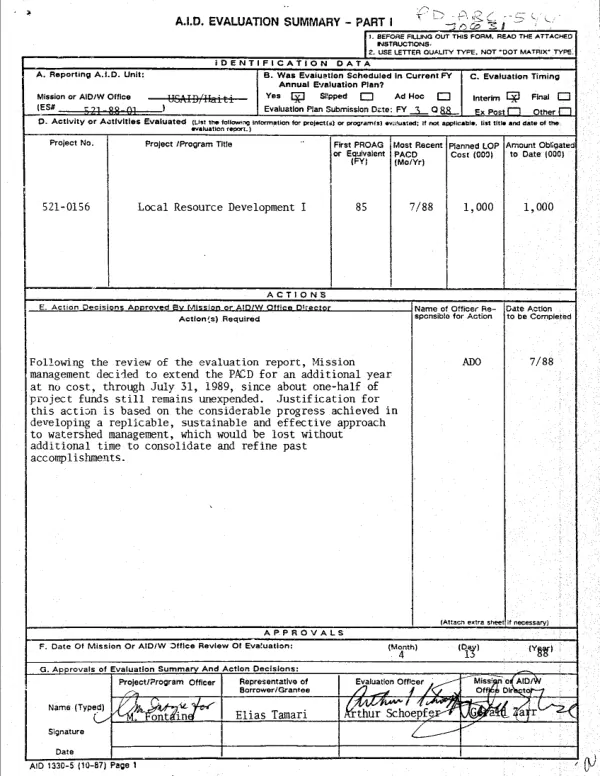
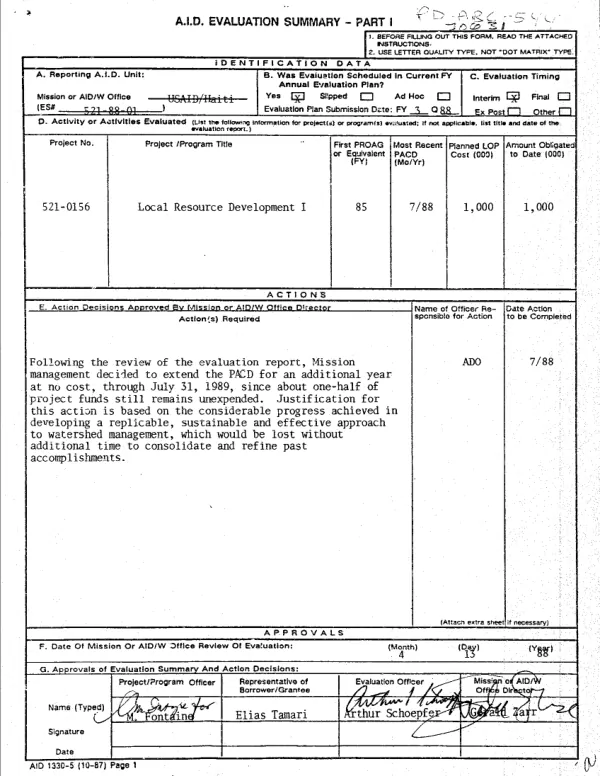
Local resource development I
Summarizes interim evaluation (XD-ABC-544-A) of a project implemented by the Save the Children Federation (SCF) to reverse environmental degradation trends on the hillsides of Maissade Commune, Haiti, by promoting participatory approaches to resource conservation.
1988
Sign in to readA free account is required to download.
Abstract
Evaluation covered the period 10/85-6/88. Despite a turbulent political climate, the project has been effective in organizing "groupements" -- community groups organized along natural social groupings, such as kinship, business, and traditional ties. The project has also been successful in using natural self-interest (increased agricultural production) rather than the artificial inducements (credit) called for in the Project Paper to motivate peasants to adopt new soil and water conservation practices. Demand has already surpassed the ability of field staff to effectively apply animation and extension services. New groupements are forming in the fringe areas of the project zone, while established ones are attaining higher levels of savings and management competence and collaborating across groupement lines. Improved soil and conservation measures are being applied on literally hundreds of plots. Although the project approach needs refinement before it can be replicated elsewhere, it has the potential -- if applied on a sustained basis -- to induce fundamental and permanent changes in peasant land management. Suggested refinements are to: (1) deemphasize tree cropping, and limit it to private lands; and (2) drop the unrealistic goal of 100% rainfall retention and absorption in the field. The project has demonstrated that poor peasants can effectively mobilize and pool their meager resources to invest in community development activities. The cost of project services per participating farmer, at $297, is less than half the projected cost. Because of this savings, the Mission has decided to extend the project one year, through 7/89, at no additional cost.
Related documents
Documents in this collection
 1988
1988USAID DEC
Peasant groups and conservation farming : an evaluation of the Save the Children pilot project in watershed management, local resource development project I
Open record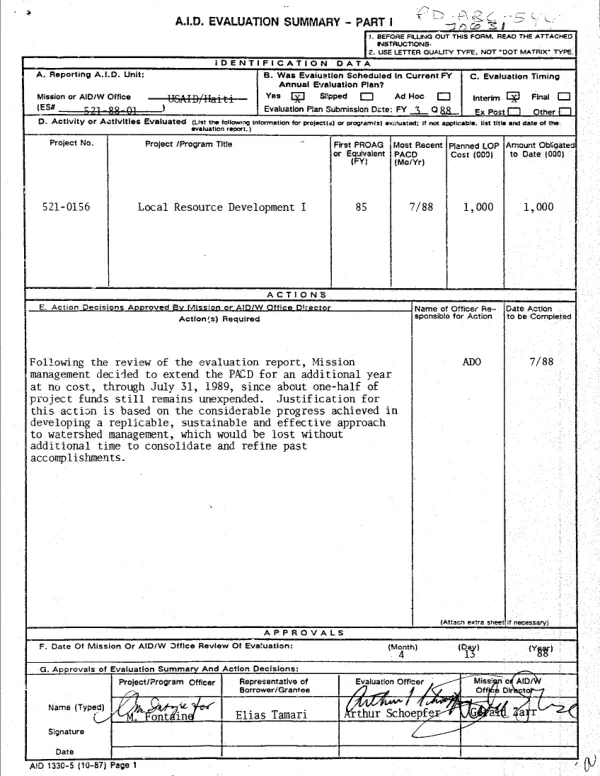 1988
1988USAID DEC