USAID. BUR. FOR SCIENCE AND TECHNOLOGY. OFC. OF RURAL AND INSTITUTIONAL DEVELOPMENT
Local revenue generation and administration
Evaluates project to develop and field test new approaches to generating local revenue or funding local development activities.
Firestine, Robert E. · 1984
Sign in to readA free account is required to download.
Abstract
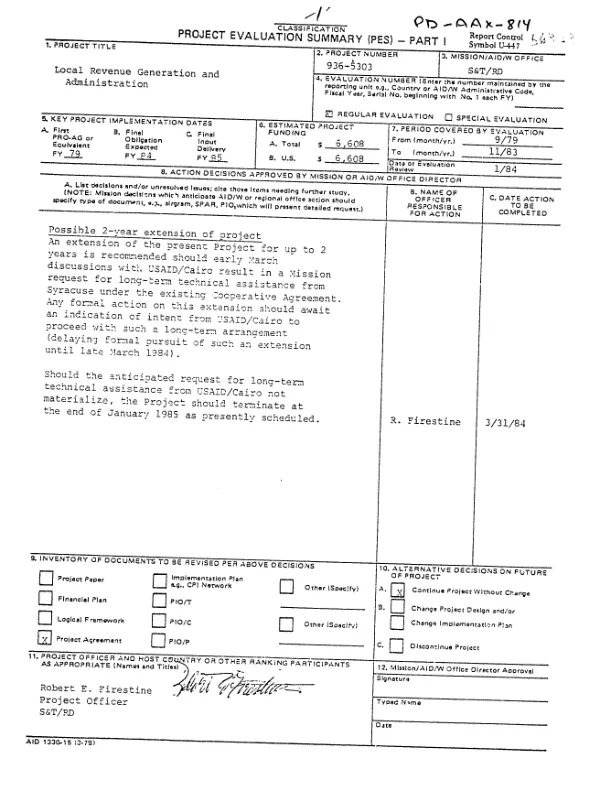
PES covers the period 9/79-11/83 and summarizes an external evaluation (not attached) based on document review, site visits, and interviews with project personnel. Although the project has several general weaknesses, overall it has made impressive gains. TA provided by Syracuse University (SU) was excellent and recipient Missions generally appear to have been pleased with the TA team. The concept of using comparative country studies of local revenue and related concerns is felt to be valid; however, while SU has focused on building new knowledge through comparative case study techniques, the development of new theoretical and operational approaches has not been a notable project output. There is a greater need to involve other researchers in more basic research on local finance. Further, too little emphasis has been given to expenditure analysis or to linking revenues and expenditures in various sectors. Finally, while the project did not achieve the objectives set forth in the logframe, those objectives were not realistic. There is a high probability that capabilities developed at Syracuse under the project will be sustained after project completion and host countries may continue to draw upon them. The project provided the following lessons. More tightly focused projects (especially when conducted through cooperative agreements) afford more controllable outputs that are more useful to the Agency than do broader, less well-focused projects. Multidisciplinary work is often more difficult to implement than anticipated. Also, it is helpful to have an A.I.D. project officer who is professionally and intellectually familiar with the subject matter of the cooperative agreement and with the approach of the implementing institution. Ideally, the project officer should have the opportunity to participate in some substantive aspect of the research of the cooperating institution.