BUREAU FOR ECONOMIC RESEARCH (BER)
Macro-economic impact of HIV/AIDS in South Africa
AIDS-related deaths in South Africa are expected to increase exponentially over the next 5 to 10 years.
Smit, Ben · 1970
Sign in to readA free account is required to download.
Abstract
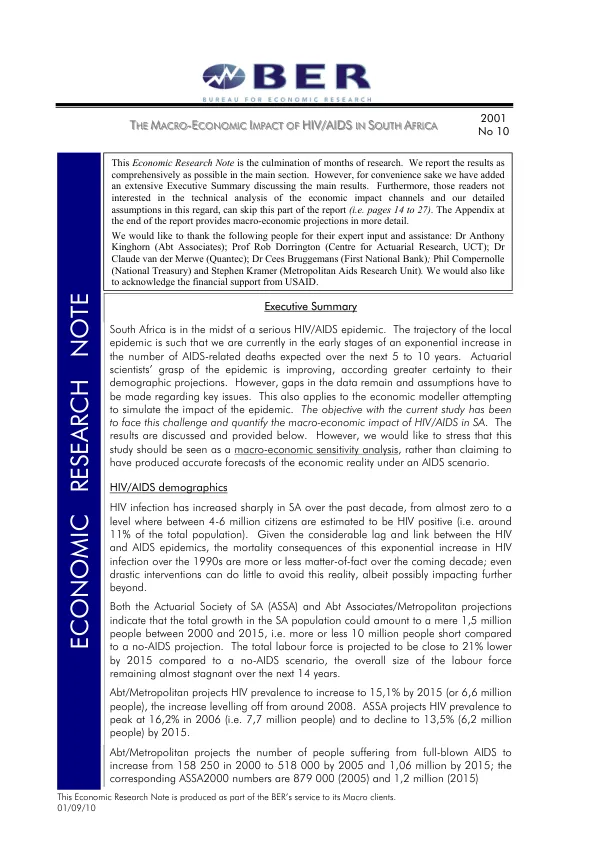
This report quantifies the possible macroeconomic impact of this growing epidemic. The study shows that, while the economic impact of HIV/AIDS is negative, we are far from witnessing a doomsday scenario. The negative impact on real GDP growth is gradual and the economy could continue to register 3% average real GDP growth (or better) over the next 10 to 15 years; inflation could still average around 7% (in line with the past 5-6 years); real interest rates may only be marginally higher; the current account deficit could average below 2% of GDP and the budget deficit below 3% of GDP. The point is that the impact lies in comparisons with the possible outcome in the absence of HIV/AIDS, something that can never really be known. At the same time, results clearly show that the macro-economic impact of the HIV/AIDS epidemic cannot be ignored. A particular feature of the overall results is the negative financial impact, which has negative feedback effects on economic growth and job creation; this impact is exacerbated by the negative impact on savings, in turn, having negative implications for fixed investment and South Africa"s balance of payments constraint on economic growth. Furthermore, the macro results may conceal more substantial negative impacts at a more disaggregated level. There could clearly be losing sectors, apart from those sectors benefitting (e.g., health care, funeral services, etc.). Further research is required in this regard. Finally, the macro-economic impact numbers convey little, if anything, of the human suffering and adverse social impacts likely to accompany the projected exponential increase in mortality and sickness.
Related documents