ACTION PROGRAMS INTERNATIONAL
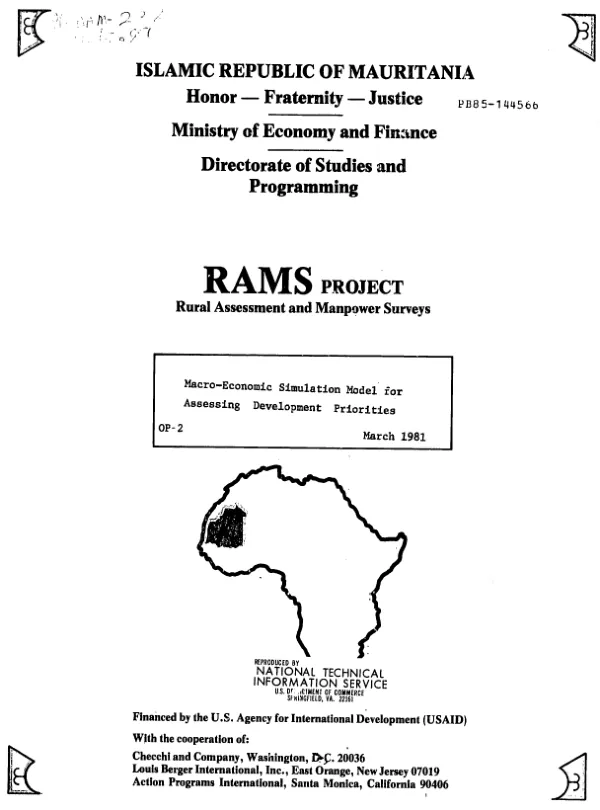
Macro-economic simulation model for assessing development priorities
To help correct Mauritania"s misguided capital-intensive development strategy, this paper presents a macroeconomic model for assessing alternative policies for growth during the period 1980-2000.
1981
Sign in to readA free account is required to download.
Abstract
Traditional, industrial, and service sector growth policies, production functions, and investment requirements are evaluated. Gross domestic expenditures and resource gaps are then calculated and results are interpreted with regard to economic and other constraints (e.g., balance of payments and debt service) and basic human needs. A global development strategy option is proposed based on growth policies and performance since the 1960"s and on calculation of financial resources and the reoriented operational goal of meeting basic human needs. It is suggested that implementation be in two waves - medium term (1980-85), stressing the establishment of financial stability, and long term (1986-2000), stressing sectoral growth. Based on a new labor-intensive thrust and calculations of export and debt capacity, projections (fiscal, balance of payment, and investment) are made for each period. Supporting data are presented in 69 tables throughout the report.
Connected topics