USAID. MISSION TO MADAGASCAR
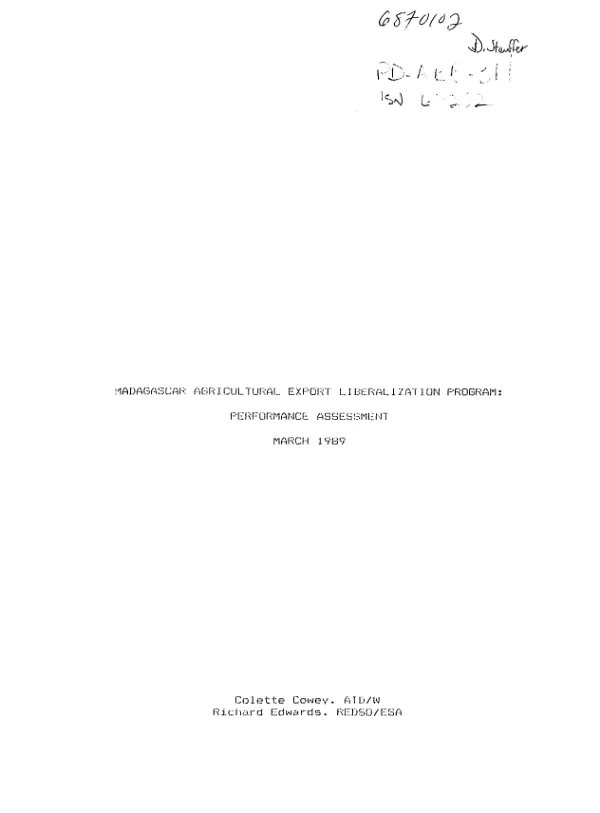
Madagascar agricultural export liberalization program : performance assessment
Interim evaluation of a program to help liberalize the export of Madagascar's traditional cash crops (coffee, cloves, and peppers) and establish a liberalized foreign exchange allocation system.
Cowey, Colette|Edwards, Richard · 1989
Sign in to readA free account is required to download.
Abstract
The evaluation covers the period 7/88-3/89. Export liberalization was officially decreed in 9/88, and information regarding this transition has been made available through an exporters' guide and newspapers. Although data are very limited, it is evident that private firms have been active in coffee purchasing and conditioning and have done reasonably well in exporting. Exporters believe that the quality of coffee is rising as the result of increased competition. However, the transition to liberalized coffee exportation has not been smooth and will take much longer than the 7-8 months originally estimated. The majority of exporters interviewed complained of the slowness of the transition and claimed that the public sector Marketing Board still controls much of the export quota as the result of previous sales agreements. Farmers are also confused about the new system and, although it appears that they are receiving increasingly higher prices, it is not clear whether these increases are the result of liberalization. Progress in liberalizing cloves exports has also been slow, partly as the result of low world market prices, but mostly because of the high export tax levied by the Marketing Board. While ten private firms are in the cloves exporting business and new firms have entered the market, no data are available on the private sector's relative share of exports. Liberalization of the pepper market has been more successful. All prior regulations have been removed, and the private sector controls an estimated 70% of total exports. Nontraditional exports have in many cases more than doubled in volume and value since 1986 (although this growth does not compensate for the losses in traditional products), and the private sector has become heavily involved in this area. The number of private marketers of lychees, for example, has increased from about 6 in 1980 to about 20 in 1988. Principal constraints appear to be insufficient local transport, excessive government regulation, and prohibitive airport/port procedures. An open general license system initiated under the program makes foreign exchange available for imports. In the majority of cases the steps required to receive foreign exchange cannot be completed within the expected 6 days. However, the system is a clear improvement over the previous one because it allows more flexibility in business and planning and encourages efficiency through reduction in inventories. Requests for foreign exchange in at least one of the three banks increased steadily throughout 1988, nearly doubling in July, when the system was expanded to all categories of imports. It is recommended that the Mission extend the terminal date for meeting conditions precedent, since performance in market liberalization has been hampered by external factors, namely, depressed world market conditions.
![Madagascar agricultural export liberalization program [: amendment]](https://covers.devme.ai/gen/71787.webp)