USAID DEC
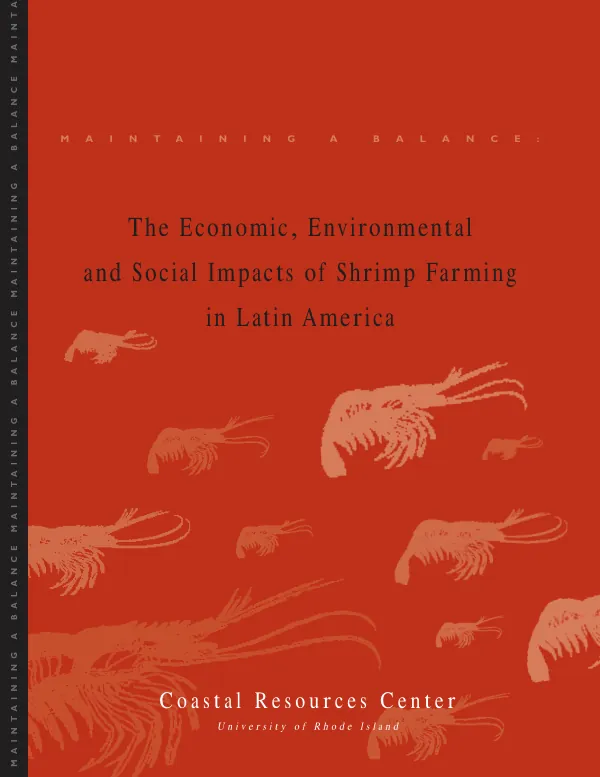
Maintaining a balance : the economic, environmental and social impacts of shrimp farming in Latin America
Sign inUNIVERSITY OF RHODE ISLAND. COASTAL RESOURCES CENTER (CRC)
Maintaining a balance : the economic, environmental and social impacts of shrimp farming in Latin America
Shrimp farming is a significant and growing export industry in Latin America and one that has important impacts on the environment and coastal communities.
Tobey, James; Clay, Jason +1 more · 1998
Sign in to readA free account is required to download.
Abstract
This paper explores the threats to the sustainability of the industry, which has developed in a way that frequently causes social and environmental problems. These threats lie principally in the absence of adequate governance mechanisms to prevent the unplanned and unregulated over-development of the shrimp industry and other human activities in specific estuaries and stretches of coasts, leading to declines in water quality, as well as to shrimp diseases, user conflicts, and ultimately reduced pond productivity or pond abandonment. The underlying causes of environmental and social problems in Latin America are complex and include poorly defined and insecure land tenure; open access property rights for water and seed shrimp; inadequate institutional capacity and environmental regulations; unworkable legal frameworks; inade- quate shrimp farm technical expertise; and inadequate understanding of coastal ecosystem conditions and trends. Integrated coastal management is suggested as a governance framework for advancing sustainable shrimp aquaculture. The multidimensional nature of the problem calls for an integrated approach to coastal economic development and environmental management. Urgently needed is a better understanding of how to address the underlying causes of these problems and to translate the principles of sustainable shrimp aquaculture into tangible practice. Specific actions explored in this paper include: (1) formulation of best management practices that lower impacts and sustain production; (2) improvement in the use of impact assessment techniques for watershed management and shrimp pond siting, design, construction, and operation; (3) formulation of trade-related incentives such as product certification schemes; (4) monitoring of estuary conditions and trends; (5) development of community management plans and user group agreements; (6) provision of extension and TA that addresses the environmental, social, and economic impacts of shrimp farming; (7) improvement of land use zoning, use of buffer zones, and use of permitting procedures; and (8) provision of incentive-based measures such as subsidized credit, donor conditionality, and water and land pricing. A second phase of USAID"s Hemispheric Free Trade Expansion Project will implement and assess several of these management approaches. Includes references. (Author abstract, modified)
![Socioeconomic aspects of coastal resource use in Talise, North Sulawesi[, Indonesia]](https://covers.devme.ai/gen/47889.webp)
![Examination and comparison of Rumbia and Minanga : control villages for the coastal resource management project sites at Bentenan and Tumbak[, Indonesia]](https://covers.devme.ai/gen/47890.webp)