U.S. PUBLIC HEALTH SERVICE. CENTERS FOR DISEASE CONTROL AND PREVENTION (CDC). INTERNATIONAL HEALTH PROGRAM OFC.
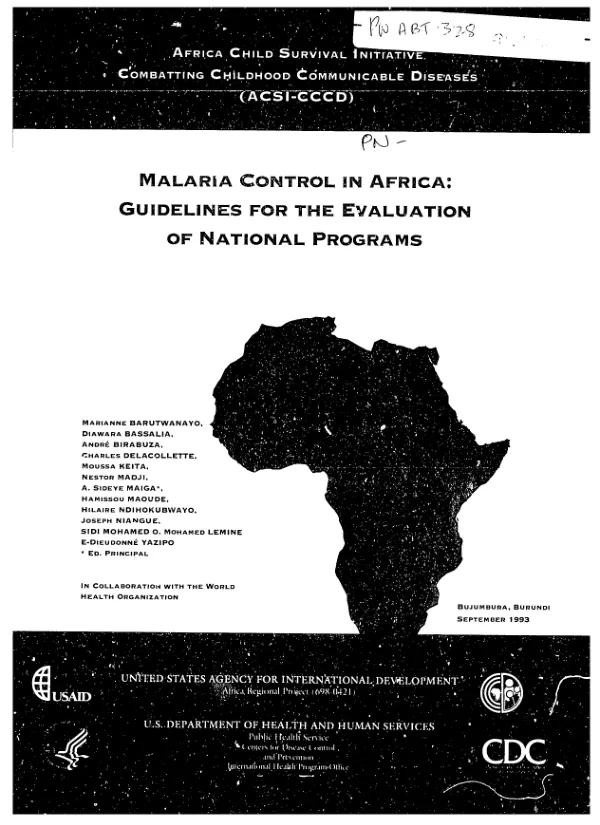
Malaria control in Africa : guidelines for the evaluation of national programs
A 1993 meeting of 12 malaria control program managers from seven countries of francophone Africa resulted in the development of these guidelines and indicators for evaluating national malaria control programs.
Barutwanayo, Marianne; Bassalia, Diawara · 1993
Sign in to readA free account is required to download.
Abstract
The introduction notes that evaluation should be an integral component of malaria control programs, carried out by managers at all levels at intervals sufficiently frequent to permit feedback and continuous improvement of programs. This approach is a necessary complement to traditional evaluation methodologies, which are usually conducted at long intervals by outside experts. Sections Two and Three of the report review evaluation types and identify 12 indicators for evaluating malaria programs. The first 4 are impact indicators: morbidity, proportional morbidity, hospital morbidity, and proportional hospital morbidity attributed to malaria. There are 8 outcome indicators: diagnosis of fever; correct microscopic diagnosis; treatment in health facilities; early consultation of febrile children; availability of antimalarial drugs; chemoprophylaxis during pregnancy; use of insecticide-impregnated bednets; and speed of the health information system. No process indicators are included, as it is recommended these be developed at the country level. Section IV explains how health information systems, observations and interviews in health facilities, and community surveys can be used to collect data needed to support the indicators. The steps involved in evaluation management are explained in Section V.