USAID DEC
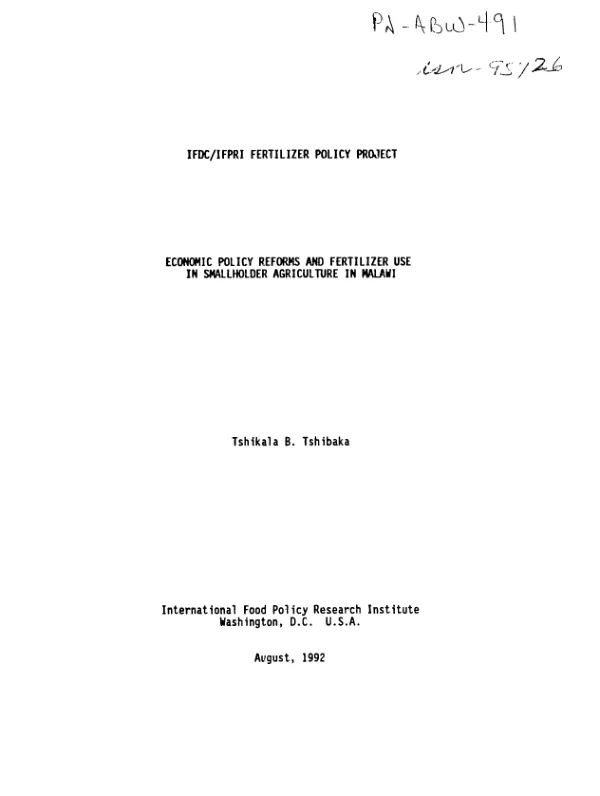
Malawi fertilizer subsidy reduction program : the impact of the African economic policy reform program
Sign inUSAID. BUR. FOR PROGRAM AND POLICY COORDINATION. CENTER FOR DEVELOPMENT INFORMATION AND EVALUATION (CDIE)
Malawi fertilizer subsidy reduction program : the impact of the African economic policy reform program
In 1985, A.I.D.
Atukorala, Vimal; Batchelder, Alan · 1990
Sign in to readA free account is required to download.
Abstract
initiated a policy reform program with the Government of Malawi (GOM) which aimed to reduce fertilizer subsidies and to cut the foreign exchange costs of fertilizer imports by substituting high analysis fertilizer (HAF) for low analysis fertilizer (LAF). In exchange, the GOM would receive cash grants totalling $15 million in three tranches. Although conditions for the first two tranches were met (cutting GOM expenditures a modest 0.2%), the GOM refused to cut the subsidy to meet the 1987/88 conditionality, and the program was canceled without the release of the third $5 million tranche. The GOM decision was based on the belief that transportation cost increases, the infusion of hungry Mozambican refugees, and lagging maize production required a higher subsidy to moderate fertilizer price increases. Currently, the GOM is committed to ending the subsidy, mainly because it believes that too much of its benefits (up to 20%) leak to large estates. On the positive side, the GOM has incrementally increased the HAF share of fertilizer imports and has passed all cost savings on to smallholder buyers. This action resulted in a 100% increase in fertilizer nutrient purchases and a 50% increase in hybrid maize production between 1984 and 1990. By 1987/88, savings from HAF substitution reached k8.0m, approaching the k8.9m spent that year on fertilizer subsidies. On a larger scale, however, the reform program did not affect other GOM policies -- e.g., restriction of burley tobacco cultivation to estates -- that seem to be depressing returns to the smallholder majority while increasing returns to the large estates. A reduction in this bias against smallholders would require broad economic policy reform.