CHEMONICS INTERNATIONAL, INC.
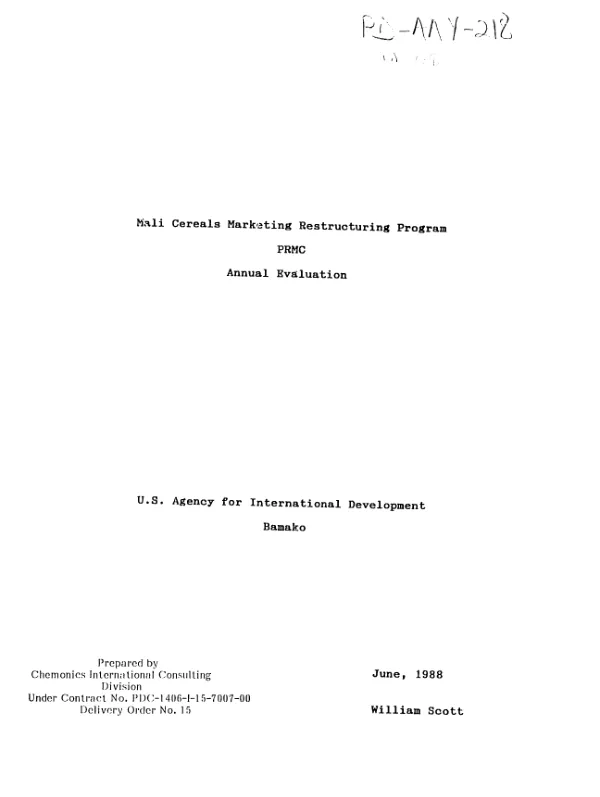
Mali cereals marketing restructuring program, PRMC : annual evaluation
Evaluates multi-donor cereals marketing restructuring program (PRMC) in Mali.
Scott, William · 1988
Sign in to readA free account is required to download.
Abstract
Evaluation covers the period 1986-6/88. Considerable progress has been made in liberalizing cereals marketing in Mali. Offical prices for coarse grains were abolished in 11/87, and the role of OPAM (a parastatal) in price support and stabilization via a regulatory stock was abolished in 12/87. OPAM was given a new mandate to manage food aid, supply deficit areas, and maintain national food security stocks. These new policies have allowed PRMC donors over the past 18 months to focus more on supporting the private market by funding credit and market information programs and less on supporting OPAM or paying for subsidies. Rice policies remain problematic. The ban on the import of rice that began in 3/87 still has not been officially lifted. However, there has been a decision to allow some rice imports, and approval of a new system of variable taxation on rice imports is expected soon. This explicitly protectionist measure - which was approved by PRMC and by the World Bank - is supposed to give Mali's rice producers time to become more competitive with the world market, but it is far from certain that the tax will be discontinued after 3 years, as scheduled, since there is little incentive for producers to reduce costs. USAID/M should continue to support PRMC by contributing food aid and, if warranted, money, but the Mission should ensure that counterpart funds are needed by PRMC and that PRMC activities are well-supervised and designed. Unneeded counterpart funds should be reprogrammed for other USAID/M projects/programs. Specific recommendations are to: (1) restrict the role of PRMC largely to policy issues, leaving the implementation of programs (e.g., credit programs) to specific donors; (2) increase supervision of credit programs; (3) increase interest rates for merchant credit programs; (4) expand the credit programs as they prove viable, but make sure they do not become a backdoor means of price support; (5) closely monitor OPAM's role as supplier of deficit areas, so that this role does not become an excuse to increase OPAM's sway; (6) consider supporting programs in transportation infrastructure, storage, and agricultural technology; (7) modify the variable tax system in 3 years to provide a declining level of protection in order to encourage producers to lower their costs; and (8) explore means of increasing intraregional trade.