USAID. MISSION TO MALI
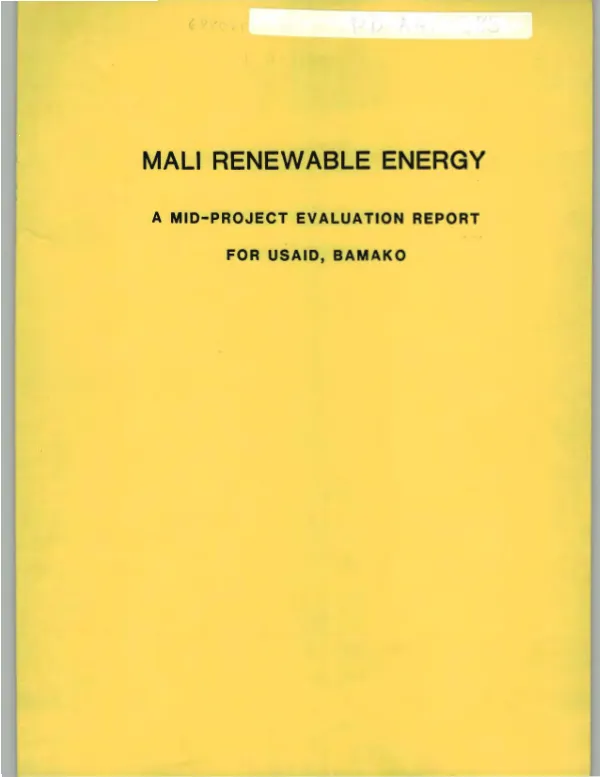
Mali renewable energy; a mid-project evaluation report, April - May 1982
Evaluates project to demonstrate the value of renewable energy in Mali and to strengthen the capacity of Mali's Solar Energy Laboratory (SEL) to foster such development.
Fall, Djibril|Graham, Richard A. · 1982
Sign in to readA free account is required to download.
Abstract
Special evaluation covers the period 9/78-5/80 and is based on site visits, interviews with project personnel, and team review of project documents. Although Phases I and II were off to a slow and rough start, performance has improved since late 1980 and is now generally favorable; continuation of the project into Phases III and IV is recommended. Implementation has been slow, particularly in securing long-term technical assistance (TA) and necessary commodities. Management could have been better on the part of all parties - USAID/M, the SEL, Solar Energy Research Institute (the TA contractor), and the Afro-American Purchasing Company (the purchasing agent). Other Malian institutions have done almost no project work to date. Th survey to collect baseline data also experienced problems. The survey design embodied in the project paper was very ambitious, but the SEL was unable to help draft survey questionnaires and the Institute d'Economie Rurale, designated to supervise the survey, provided poor logistic support in the field. Nonetheless, the survey furnished a valuable characterization of rural energy use. Installation of the four early start photovoltaic pumps was delayed 18 months due to lack of attention by USAID/M and the SEL. Prototype development by the SEL is promising but should be redirected on the basis of preliminary results from the survey and technical and economic analyses. Since pumping water, grinding grain, and farm labor are the most pressing rural needs, emphasis should be on photovoltaics, wind energy, stoves, biogas, and dryers. A total of 25 recommendations are provided regarding the SEL, TA, and the focus of future energy technology work in Mali.
Related documents
Documents in this collection
USAID DEC
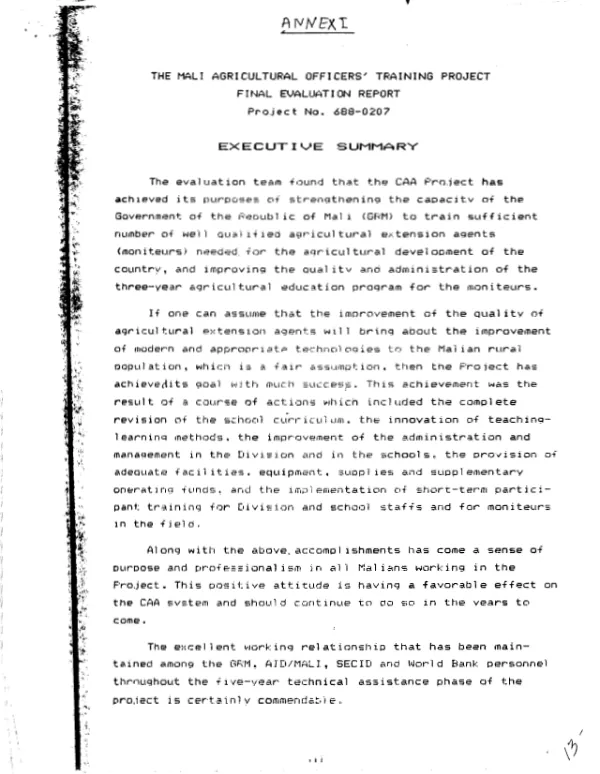
Mali agricultural officers' training project : final evaluation report, project no. 688-0207 -- executive summary
Open record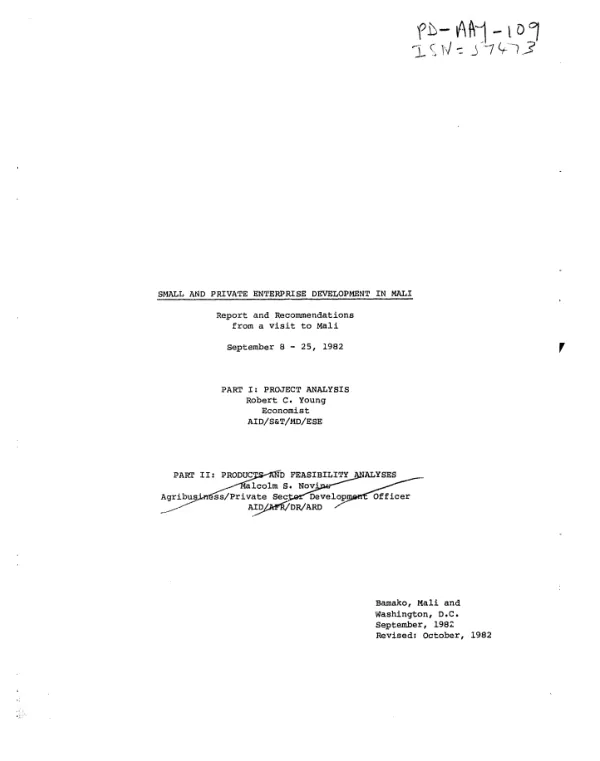 1982
1982USAID DEC
Small and private enterprise development in Mali : report and recommendations from a visit to Mali, September 8-25, 1982 -- part 1, project analysis
Open record