USAID DEC
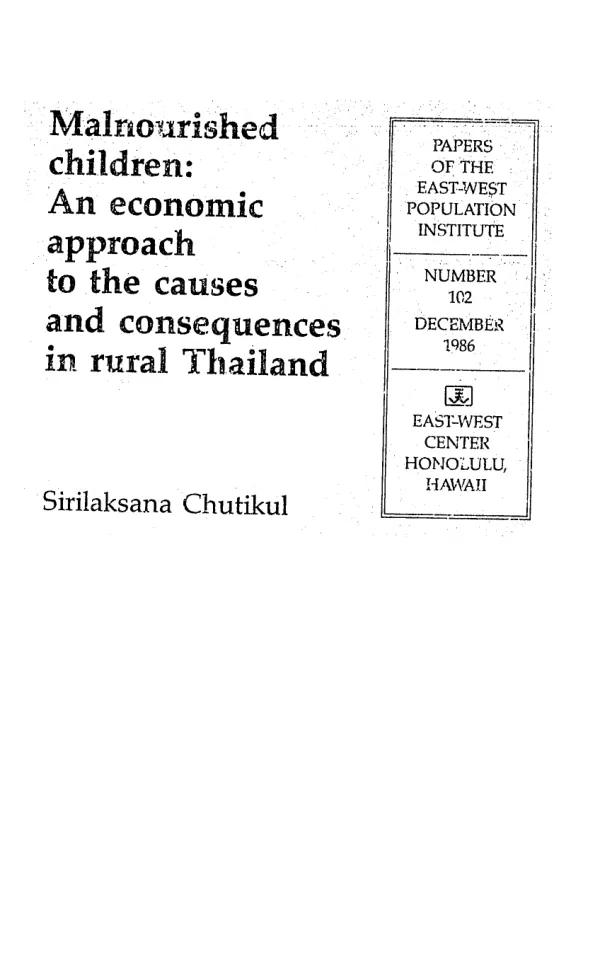
Malnourished children : an economic approach to the causes and consequences in rural Thailand
Sign inEAST-WEST CENTER (EWC). EAST-WEST POPULATION INSTITUTE
Malnourished children : an economic approach to the causes and consequences in rural Thailand
This economic analysis of the causes and consequences of malnutrition in young children in rural Thailand views parents as productive agents who make interrelated decisions regarding family size, labor force participation, expenditures, and intrahousehold resource distribution in the face of constraints imposed by their resource limitations and their particular "production technology."
Chutikul, Sirilaksana · 1986
Sign in to readA free account is required to download.
Abstract
Using data on preschool and school children obtained from a village-level survey in Northeastern Thailand, the study finds a familiar pattern: low income, high fertility, low nutrient intake, and poor nutritional status and health. One unexpected finding, however - that a mother"s formal employment is detrimental to child nutrition - has important policy implications regarding job creation and income generation. Malnutrition and high fertility are also shown to have adverse effects on the mental ability of school-age children. Further, by controlling for environmental factors, the study offers some evidence that malnutrition has a direct and independent link to poor mental ability. (Author abstract, modified.)
Connected topics
![Nutrition and health surveillance in rural West Java[, Indonesia] : key results for the period Feb 1999-Jul 2001](https://covers.devme.ai/gen/49426.webp)

![Nutrition and health surveillance in rural West Sumatra[, Indonesia] : key results for the period Aug 1999-Aug 2001](https://covers.devme.ai/gen/49429.webp)
![Nutrition and health surveillance in rural Banten[, Indonesia] : key results for the period Feb 1999-Jul 2001](https://covers.devme.ai/gen/49427.webp)
![Nutrition and health surveillance in rural Lampung[, Indonesia] : key results for the period Apr 2000-Jul 2001](https://covers.devme.ai/gen/49428.webp)
![Nutrition and health surveillance in rural East Java[, Indonesia] : key results for the period Feb 1999-Aug 2001](https://covers.devme.ai/gen/49423.webp)