CHECCHI AND CO. CONSULTING, INC. (CCCI)
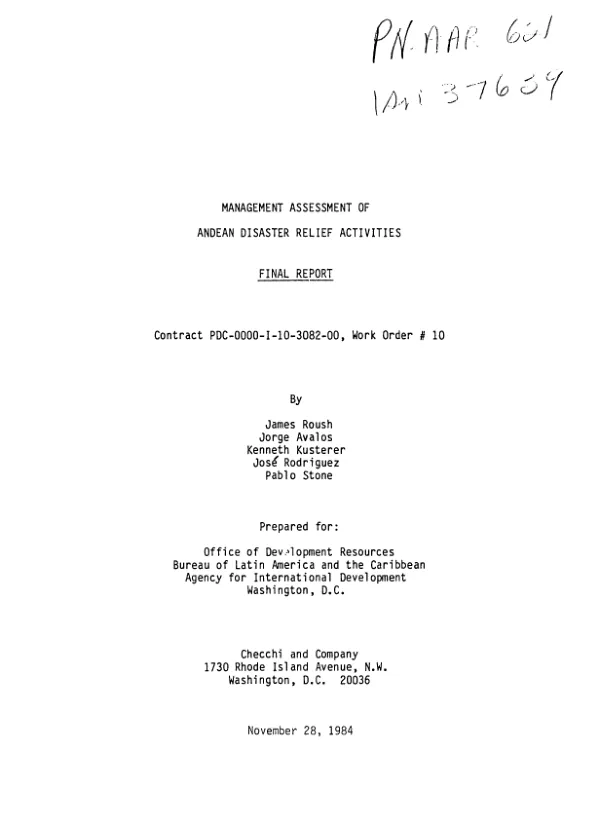
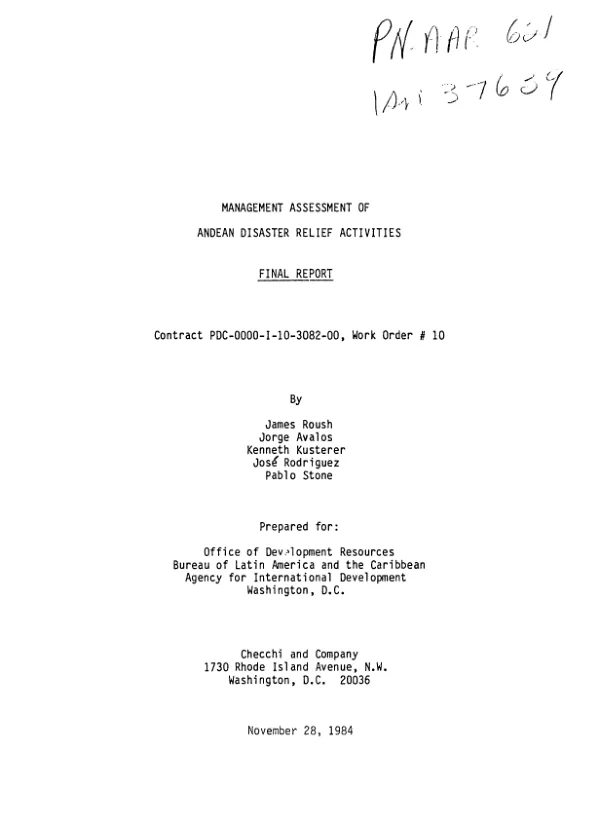
Management assessment of Andean disaster relief activities : final report
Evaluates management of A.I.D."s disaster aid in response to extreme flood and drought conditions in Ecuador, Bolivia, and Peru following El Nino in 1983.
Roush, James; Avalos, Jorge · 1984
Sign in to readA free account is required to download.
Abstract
Special evaluation covers the period Spring 1983-Summer 1984 and is based on document review, site visits, and interviews with personnel of USAID"s, host country agencies, and other active relief agencies. Overall, USAID"s quickly and efficiently established very relevant disaster programs under extremely adverse conditions. Emergency relief through the U.S. Office of Foreign Disaster Assistance was praised by Missions and government officials in all three countries. Food assistance met both relief and recovery needs despite numerous problems and wide variation in the capacity of cooperating organizations. Emergency Title II and III aid in Bolivia, which ended in 7/84, achieved price stabilization in urban areas despite poor host country management and helped avert rural malnutrition and outmigration; targeted rice sales were particularly impressive. Emergency Title I and II projects in Peru, expected to end in early 1985, have had like results. Disaster recovery projects in the 3 countries have varied in structure and implementation. In Bolivia, implementation has resembled the traditional project approach, but due to Bolivia"s economic and political troubles and attendant bureaucratic inefficiency, USAID/B played a larger role than usual (despite its own personnel and funding constraints). Some activities are behind schedule, but the project may be completed on time in 12/85. USAID/Peru has funded activities chosen by a Government of Peru coordinating agency, which has been strengthened in the process. As 15 of Peru"s 17 affected departments are receiving assistance, organizing the project has taken some time (86 subprojects are involved), and funding has been piecemeal; nevertheless, completion in 7/86 is anticipated. Disaster recovery in Ecuador consists primarily of infrastructure rehabilitation, which is ahead of schedule despite technical and transportation problems, and a loan to import agricultural inputs, which has begun just recently. Eighteen recommendations address disaster preparedness and planning, emergency food assistance, and disaster response projects.
![Provision of seeds to drought affected people in Eastern and Central Tigray[, Ethiopia] : an evaluation](https://covers.devme.ai/gen/19844.webp)