USAID. BUR. FOR PROGRAM AND POLICY COORDINATION. CENTER FOR DEVELOPMENT INFORMATION AND EVALUATION (CDIE)
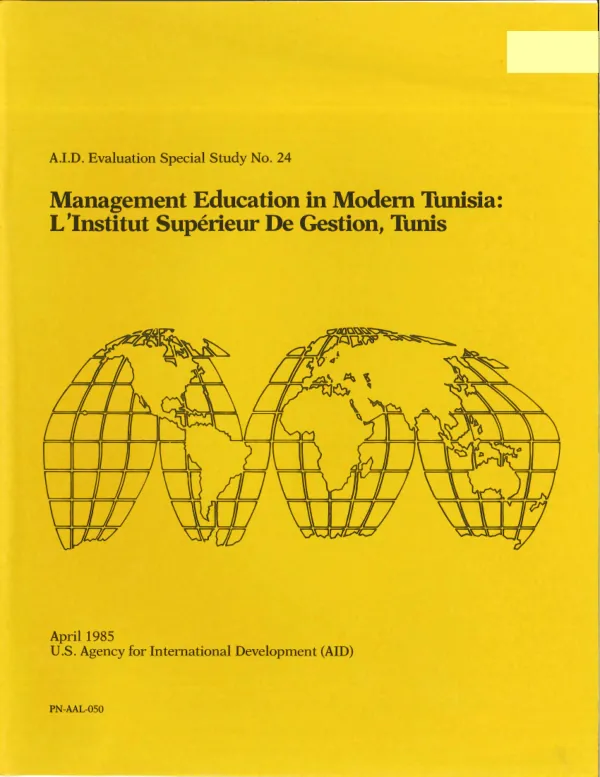
Management education in modern Tunisia : L'Institut Superieur de Gestion, Tunis
With the help of technical assistance and overseas faculty training from A.I.D., the first graduate school of business administration in North Africa, l'Institut Superieur de Gestion (ISG), was founded at the University of Tunis (UT) in 1969.
Casstevens, Thomas W.|Johnson, Nancy C.|King, Gundaar J.|Willens, Liliane · 1985
Sign in to readA free account is required to download.
Abstract
Initially, ISG offered only a 3rd cycle program modeled on the American M.B.A.; at the Government of Tunisia's urging, however, 1st and 2nd cycle (undergraduate) programs were added. ISG's institutional spinoffs are quite impressive. A Faculty of Economics and Management was founded in Sfax; its dean is a former ISG dean. Other ISG faculty have joined the Institute of Advanced Commercial Studies and the Faculty of Law, Politics, and Economics; ISG 3rd cycle graduates are now junior faculty at UT. ISG has fostered upward social mobility - its graduates, most of whom are from low-income families and many of whom are women, have little difficulty finding good jobs. On the other hand, ISG's popularity has created a problem, as other institutions have raided not easily replaceable doctoral faculty. Another problem (recently resolved through policy dialogue) was the reluctance of Tunisian officials to accept the American Ph.D. as the equivalent of the French Doctorat d'Etat. Although the goal of 25-40 3rd cycle graduates annually was reduced to 10-12, the addition of 1st and 2nd cycles, which graduate 100 and 150-200 students respectively, has increased the total number of graduates. While A.I.D. may have withdrawn its technical assistance too soon for best results, the project was nevertheless a very successful example of institution building and technology transfer because it was appropriate to Tunisia's needs as a middle-income country with a rapidly growing economy. The project has taught several commonplace, yet important lessons: (1) a project is more likely to succeed if objectively appropriate and subjectively desired by the host country; (2) institution building is a long-term affair; (3) the renewal of cadres is indispensable in the long run; (4) competing demands for trained personnel tend to disperse that scarce resource; (5) a viable institution adapts to its environment and often diverges from its original plans; and (6) a project's spinoffs may be more significant than the project itself.