INTERNATIONAL RICE RESEARCH INSTITUTE (IRRI)
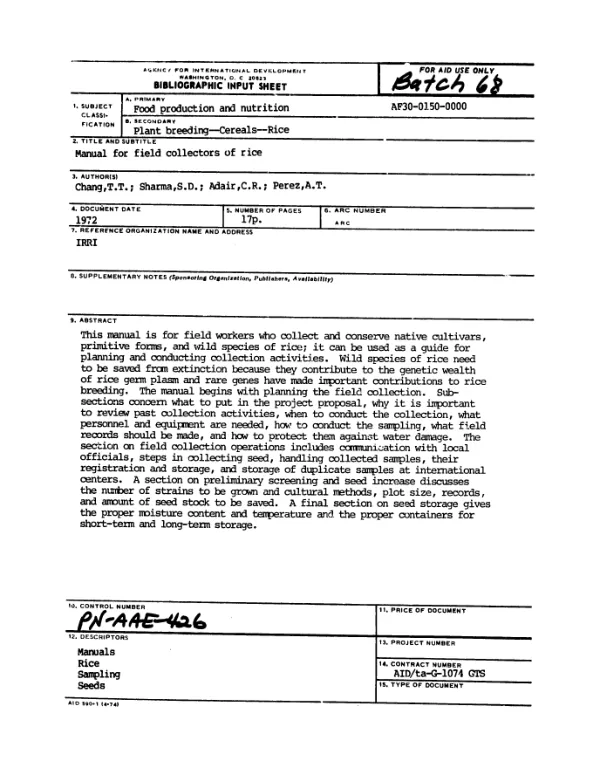
Manual for field collectors of rice
This manual is for field workers who collect and conserve native cultivars, primitive forms, and wild species of rice; it can be used as a guide for planning and conducting collection activities.
Chang, T. T.; Sharma, S. D. · 1970
Sign in to readA free account is required to download.
Abstract
Wild species of rice need to be saved from extinction because they contribute to the genetic wealth of rice germ plasm and rare genes have made important contributions to rice breeding. The manual begins with planning the field collection. Subsections concern what to put in the project proposal, why it is important to review past collection activities, when to conduct the collection, what personnel and equipment are needed, how to conduct the sampling, what field records should be made, and how to protect them against water damage. The section on field collection operations includes communication with local officials, steps in collecting seed, handling collected samples, their registration and storage, and storage of duplicate samples at international centers. A section on preliminary screening and seed increase discusses the number of strains to be grown and cultural methods, plot size, records, and amount of seed stock to be saved. A final section on seed storage gives the proper moisture content and temperature and the proper containers for short-term and long-term storage.
Connected topics

![Implementation manual : planning an international [tree seed] symposium in Pakistan](https://covers.devme.ai/gen/14330.webp)