USAID DEC
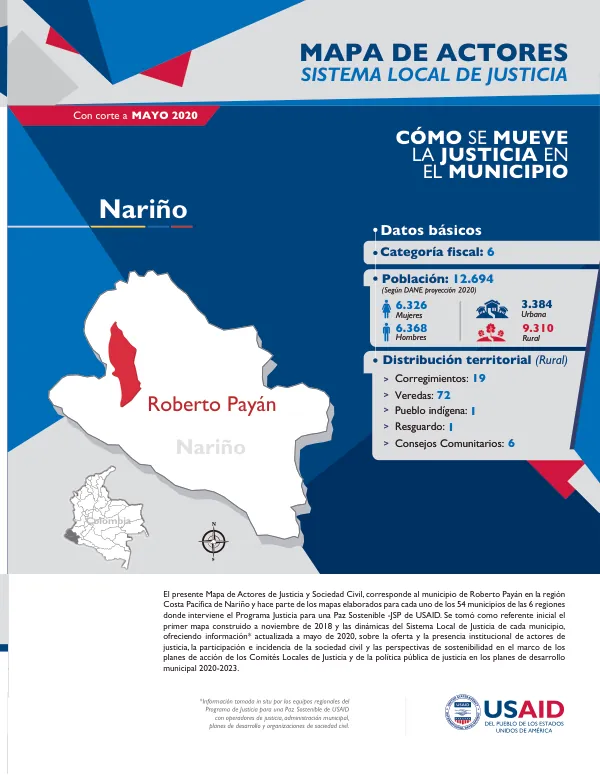
Mapa de Actores de Justicia y Sociedad Civil en el Municipio de Roberto Payán, Nariño
Sign inUSAID
Mapa de Actores de Justicia y Sociedad Civil en el Municipio de Roberto Payán, Nariño
The municipality of Roberto Payán in the Costa Pacífica region of Nariño, Colombia, has a complex system of justice that involves various actors and institutions.
2020 · 6 pages
Sign in to readA free account is required to download.
Abstract
The municipality has a population of 12,694 people, with 6,368 men and 6,326 women, according to the 2020 projection by the National Administrative Department of Statistics (DANE). The municipality has a Comisaría de Familia, which is responsible for addressing family conflicts and providing support to victims of domestic violence. The Comisaría de Familia is headed by a Comisario(a) and has a team of inspectors and secretaries. The municipality also has a Personería Municipal, which is responsible for representing the interests of the municipality and its citizens. The municipality has a Justicia Comunitaria system, which involves mediators and conciliators who work to resolve conflicts and disputes in a community-based setting. The municipality has 7 mediators, 5 conciliators, and 4 conciliators in law who have been trained to work with the community. The Justicia Comunitaria system is supported by the Policía Judicial de Barbacoas and the Fiscalía de Barbacoas. The municipality has a Comité Local de Justicia (CLJ), which is an articulator of the Sistema Local de Justicia. The CLJ is composed of actors from the justice system, including the Juzgado, Comisaría de Familia, Inspección de Policía, and Personería Municipal. The CLJ also includes organizations from the civil society, such as the Secretariado Diocesano de Pastoral Social and the Asociación Agencia de Comunicación del Pacífico. The CLJ has a Plan de Acción that prioritizes the following lines of work: modifying the Acuerdo Municipal to expand the participation of other actors of justice and expanding the team of the Comisaría de Familia and Inspección de Policía. The CLJ also aims to support the strategy of mediation in schools, capacitate members of the CLJ in attention to differential population, and fortify the justice own Afro and councils community in development of the process advanced with ASOCOETNAR. The municipality has a strong presence of organizations from the civil society, including the Secretariado Diocesano de Pastoral Social, the Asociación Agencia de Comunicación del Pacífico, and the Fundación Afrocolombiana Arcoiris. These organizations are working to promote the access to justice and the rights of vulnerable populations, such as women, victims of the conflict, and the LGBT population. The municipality has a strategy to promote the access to justice and the rights of the Afro population, which involves promoting a greater recognition of the practices and customs of the Afro communities related to their own justice and understanding with the ordinary justice. The municipality also aims to fortify the Comisaría de Familia in the expedition of measures of protection to victims of VBG with ethnic approach, with the support of the national partner Sisma Mujer. The municipality has a strategy to promote the access to justice and the rights of the LGBT population, which involves promoting differential attention and understanding with the ordinary justice. The municipality also aims to diffuse routes and protocols of attention of VBG and fortify organizations for the support psychosocial and juridical to victims of VBG. The municipality has a strong commitment to promoting the access to justice and the rights of vulnerable populations, and has established a number of strategies and initiatives to achieve this goal. The municipality has a complex system of justice that involves various actors and institutions, and has a strong presence of organizations from the civil society that are working to promote the access to justice and the rights of vulnerable populations.