NAMIBIA RESOURCE CONSULTANTS
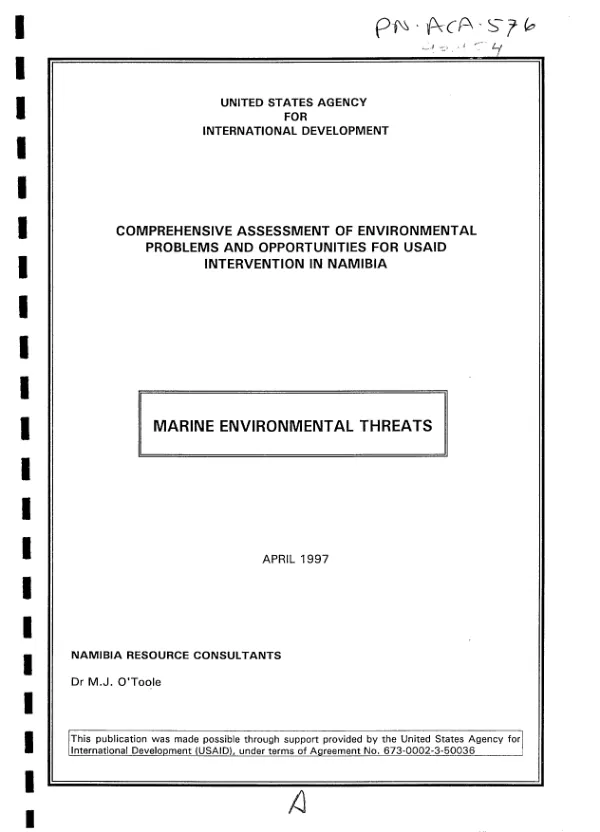
Marine environmental threats
This report summarizes and assesses environmental threats facing the marine environment and its living resources off the coast of Namibia.
O"Toole, M. J. · 1997
Sign in to readA free account is required to download.
Abstract
Section 1 provides an overview of the marine biophysical environment off the coast, covering: features of the northern Benguela Current, and the biological resources and habitat types of the region; commercial fisheries, including descriptions of the status of stocks; the regional importance of the Benguela Current as a large marine ecosystem, and some of the fisheries and oceanographic research undertaken in parts of the system; and the status of marine industries, such as diamond mining, offshore oil and gas exploration, and exploitation and commercial development. Section 2 discusses trends taking place in the marine environment ranging from the natural variability within the Benguela Current system to major perturbations such as the anomalous conditions that occurred off the Namibian coast between 1993 and 1995. These conditions include increased eutrophication leading to low oxygen conditions in shelf waters to major phytoplankton blooms, localized sulphur eruptions, and the occurrence of Benguela Nino events. Also discussed are trends taking place within the fisheries as a result of past over-exploitation, and environmental effects such as regime shifts, changes in trophic levels, and species flips. The section also identifies the environmental threats from developments taking place in population centers along the coast, including those associated with harbor activities and fish processing and recreational fishing (tourism), including the degradation of water quality, oil spills, red-tide blooms and over-exploitation of recreational fish by numerous anglers. The environmental effects of marine diamond mining activities, particularly on rock lobster stocks, are also outlined. The direct and indirect causes of real and perceived marine environmental problems are summarized in Section 3. These vary from fluctuations in environmental conditions and impacts on fisheries to pollution and dumping of waste, uncontrolled coastal developments, and marine diamond mining. Gaps are identified in Section 4 where additional information and participatory involvement is required and where further research and monitoring is needed. Section 5 lists some strategic options and interventions to mitigate current and perceived threats facing Namibia"s marine environment. One of the best means of tackling future threats would be implementation of an integrated regional management plan for the Benguela Current as a large marine ecosystem. (Author abstract, modified)
Related documents