ADVANCED ENGINEERING ASSOCIATES INTERNATIONAL, INC. /SGGA
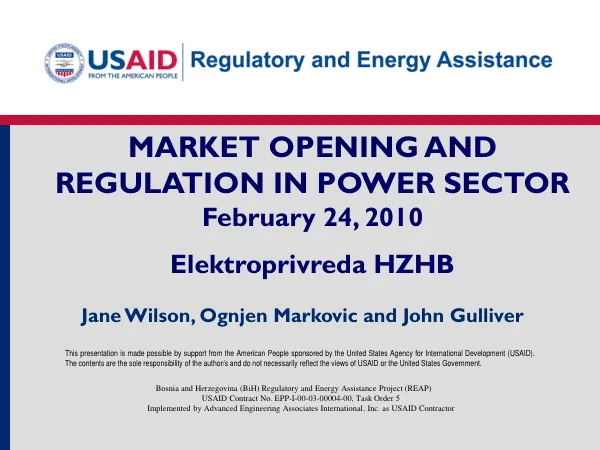
Market Opening and Regulation in Power Sector
Market opening and regulation in the power sector in Bosnia and Herzegovina (BiH) is a critical component of the country's energy policy.
2010 · 22 pages
Sign in to readA free account is required to download.
Abstract
The BiH Regulatory and Energy Assistance Project (REAP) aims to facilitate market opening and regulation in the power sector. The project is implemented by Advanced Engineering Associates International, Inc. as the USAID contractor. Market opening involves transitioning from a fully regulated system to one where energy, capacity, and other services are purchased and sold at negotiated prices. This process is already a policy in BiH, required by State and Entity Laws, as well as the Energy Community Treaty. Eligible customers can enter into bilateral contracts for services available in the open market, with companies such as Aluminij and BSI already beginning to offer these services. This new environment presents challenges for Elektroprivreda HZHB (EP), the dominant electricity supplier in BiH. The implications of eligible customer choice are significant, with potential cost and revenue impacts on EP and remaining customers. Accurate and time-differentiated metering is critical for billing and settlement, and EP must ensure that necessary metering, billing, and contracts are in place. The role of regulators is also crucial in overseeing the market opening process and ensuring that EP meets its obligations. Critical conditions for market opening include accurate and time-differentiated metering, cost-based tariffs for all functions, protection for vulnerable customers, unbundled functions and diverse supply, and deregulation of generation. Metering is considered the most important factor, with remote reading capability necessary for wholesale and retail transactions. This will enable the monitoring of participant behavior and measurement of losses. Cost-based tariffs are essential for allowing full cost recovery of justified costs, correct allocation, and reduction of cross-subsidization. However, the impact on the ability to pay must be considered, particularly for vulnerable customers. Utilities and tariff customers currently subsidize vulnerable customers, which is inefficient and should be a public obligation rather than a utility or customer responsibility. Vulnerable customers in BiH are not protected by social programs, and a specific program must be developed and implemented to identify and support these customers. Funding for this program could come from the government budget, and block tariffs with lower rates for lower usage may be considered. However, research shows a weak correlation between block tariffs and usage, suggesting that this solution may not be effective. The development of specific programs to protect vulnerable customers is essential for ensuring that market opening and regulation in the power sector in BiH are equitable and fair. This will require careful consideration of the needs of vulnerable customers and the development of effective solutions to support them.