USAID DEC
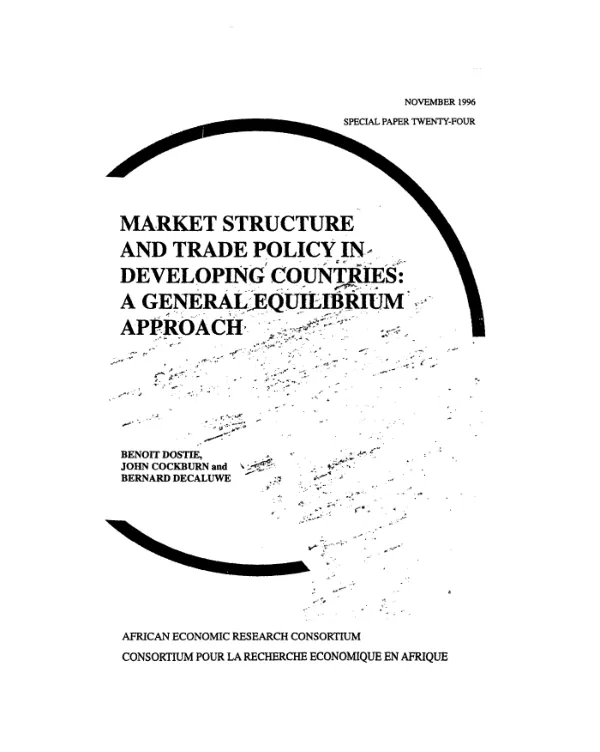
Market structure and trade policy in developing countries : a general equilibrium approach
Sign inAFRICAN ECONOMIC RESEARCH CONSORTIUM (AERC)
Market structure and trade policy in developing countries : a general equilibrium approach
Trade policy analysis has experienced major changes over the last decade on both the theoretical and empirical fronts.
Dostie, Benoit; Cockburn, John +1 more · 1996
Sign in to readA free account is required to download.
Abstract
The "new" trade theory points out that the presence of imperfect competition in a market renders theoretically ambiguous the magnitude and the direction of trade policy effects, particularly on resource allocation, factor payments, and welfare. On the empirical front, the computable general equilibrium model (CGEM) has emerged as a leading tool for empirical analysis of trade policy. This paper explores the convergence of these two developments -- CGEMs with imperfect competition -- and their applicability to developing countries. For these countries, the principal application of this theory is in the study of the impact of trade policy when domestic markets behave in a non-competitive way. In particular, taking into account the market power of local firms on the domestic market can modify the magnitude and the direction of welfare changes and resource reallocations to be expected from trade liberalization. A survey of CGEMs with imperfect competition shows that these impacts depend on the way imperfect competition is modeled. A case study is presented to illustrate the ambiguous effects of trade policy with a series of simple CGEMs with and without imperfect competition and scale economies. Includes references. (Author abstract)