USAID DEC
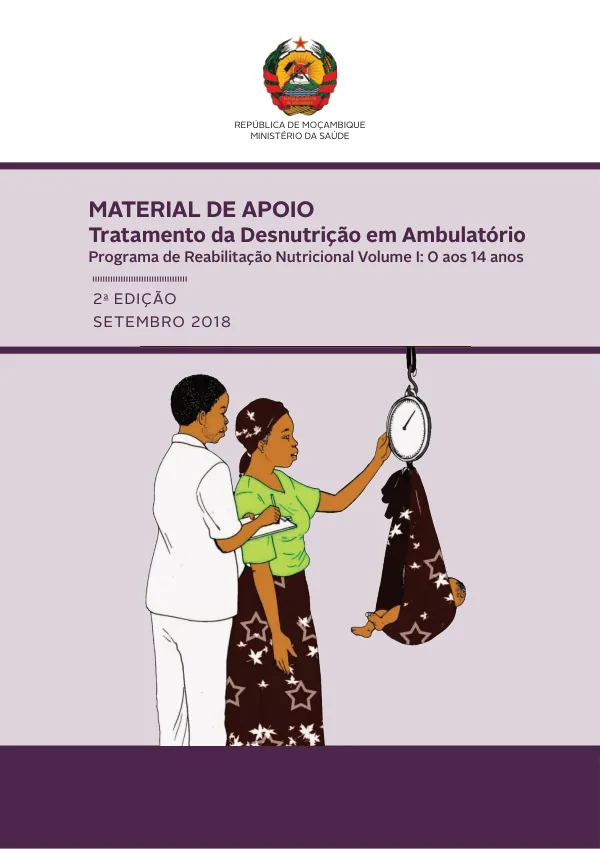
MATERIAL DE APOIO Tratamento da Desnutrição em Ambulatório Programa de Reabilitação Nutricional Volume I: 0 aos 14 anos
Sign inMINISTÉRIO DE SAÚDE
MATERIAL DE APOIO Tratamento da Desnutrição em Ambulatório Programa de Reabilitação Nutricional Volume I: 0 aos 14 anos
The Ministry of Health in Mozambique has developed a program for the treatment of acute malnutrition in children from 0 to 14 years old.
2018 · 34 pages
Sign in to readA free account is required to download.
Abstract
The program is outlined in a document titled "Tratamento da Desnutrição em Ambulatório" and is intended for use in outpatient settings. The program begins with the identification of acute malnutrition in children, which is defined as a weight-for-height or weight-for-age z-score below -3 standard deviations. The program uses a classification system to categorize children as having severe acute malnutrition (SAM), moderate acute malnutrition (MAM), or no acute malnutrition. Children with SAM are treated with a therapeutic diet, which includes a ready-to-use therapeutic food (RUTF) called ATPU. The treatment plan involves three phases: stabilization, transition, and rehabilitation. During the stabilization phase, children are given F75, a pre-packaged therapeutic food. In the transition phase, F75 is gradually introduced with the RUTF, and in the rehabilitation phase, the RUTF is given alone. Children with MAM are treated with a supplementary therapeutic food (STF) called ASPU or ATPU, depending on their age. The treatment plan involves two phases: stabilization and rehabilitation. During the stabilization phase, children are given F75, and in the rehabilitation phase, they are given the STF. The program also includes guidelines for the management of children with complications, such as edema, convulsions, and diarrhea. Children with complications are treated with a more intensive therapeutic diet and may require hospitalization. The program emphasizes the importance of education and nutrition counseling for children and their caregivers. Children are educated on proper nutrition and hygiene practices, and caregivers are taught how to prepare and feed their children a nutritious diet. The program also includes guidelines for the discharge of children from treatment. Children are discharged when they meet certain criteria, such as having a weight-for-height or weight-for-age z-score above -1 standard deviation, having no edema, and being able to eat a normal diet. The program is intended for use in outpatient settings, such as community health centers and hospitals. It is designed to be used by healthcare workers who have received training in the management of acute malnutrition. The program includes a number of tools and resources, such as a classification system for acute malnutrition, a treatment plan, and guidelines for the management of complications. It also includes a list of recommended medications and nutritional supplements. Overall, the program is designed to provide a comprehensive approach to the treatment of acute malnutrition in children from 0 to 14 years old. It emphasizes the importance of education and nutrition counseling, and provides guidelines for the management of complications. The program is based on the World Health Organization's (WHO) guidelines for the management of acute malnutrition, and is intended to be used in conjunction with other health programs and services. The program includes a number of key components, including: * A classification system for acute malnutrition * A treatment plan for children with SAM and MAM * Guidelines for the management of complications * Education and nutrition counseling for children and their caregivers * Guidelines for the discharge of children from treatment * A list of recommended medications and nutritional supplements The program is based on the latest scientific evidence and is consistent with international guidelines for the management of acute malnutrition. It is designed to be flexible and adaptable to different settings and populations.
Related documents
Documents in this collection
 2015
2015USAID DEC
Estratégia de Comunicação para a Mudança Social e de Comportamento para a Prevenção da Desnutrição em Moçambique 2015-2019
Open record 2012
2012USAID DEC