USAID DEC
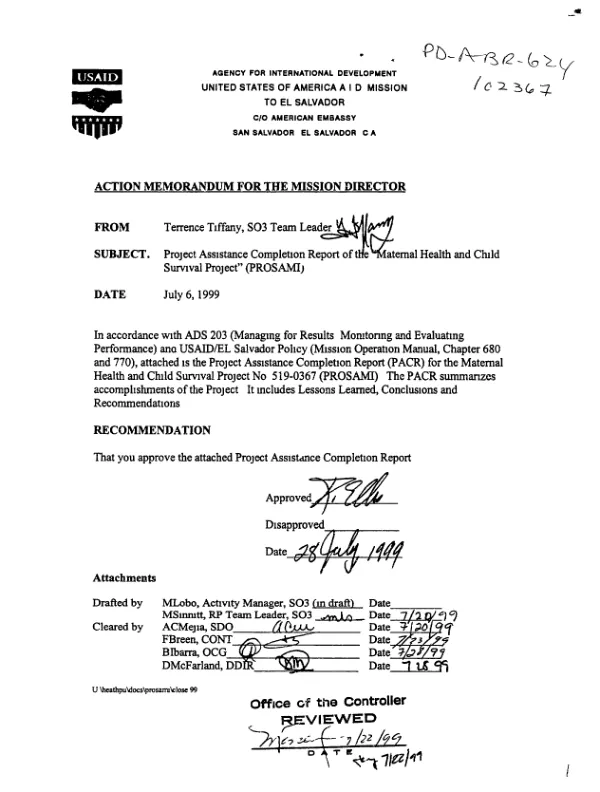
Maternal health and child survival project, PROSAMI : project no. 519-0367 -- project assistance completion report
Sign inUSAID. MISSION TO EL SALVADOR
Maternal health and child survival project, PROSAMI : project no. 519-0367 -- project assistance completion report
PACR of a project (1990-98) to expand community-based maternal health and child survival (MH/CS) services through NGOs in underserved areas of El Salvador (PROSAMI project).
1999
Sign in to readA free account is required to download.
Abstract
PROSAMI had three major components. (1) The delivery of MH/CS services component included: prenatal and neonatal health promotion, nutritional supplementation and promotion of breastfeeding for the first 6 months of life, growth monitoring, control of diarrheal diseases and acute respiratory infections, reproductive health, and vaccines for 6 preventable diseases. (2) The NGO institutional development component provided TA in training, monitoring and evaluation, technical information, and management training in finance and logistics. Among other benefits, this training enabled NGOs to: organize national workshops and conferences, including local and international participation; prepare workplans and strategies for sustaining and strengthening institutional capacity; and develop linkages between the participating NGOs and the donor community. (3) The policy development and research component provided a forum and mechanism for coordinating health sector activities and included collaboration with international institutions such as UNICEF, PLAN INTERNATIONAL, PAHO/WHO, UNFPA, WFP/FAO, and with the Government of El Salvador (GOES). Under this component, the NGOs implemented agreements such as revolving funds for essential medicines (based on UNICEF's BAMACO Initiative). Other coordination efforts included agreements with other NGOs for service delivery, including an agreement with the Salvadoran Demographic Association for family planning; coordination with the National University; and participation in the 1998 health survey, (FESAL 1998). All but 5 of the 30 participating NGOs continue to provide MH/CS services. However, service delivery has been reduced. Either the NGOs have reduced the number of people they serve or have altered the types of services they provide, or the health promoters have become volunteers. Seven of the NGOs are receiving funds from other donors. Quantitative achievements of PROSAMI were as follows: (1) The project strengthened the technical and management performance of more than 150 NGOs in El Salvador and at one point developed a network of 36 local health service-related NGOs. (2) PROSAMI provided health services to some 440,000 rural Salvadorans, 100,000 above target. (3) A total of 180,000 women and children had access to high-quality MH/CS services delivered through Salvadoran NGOs. (4) The infant mortality rate in the project areas was reduced from 40 to 12 per 1000 live births, and deaths due to acute respiratory infections declines from 20 to 3 per 10,000. (5) The maternal mortality rate was reduced to 0 in 1997 and has remained there through mid-1998. (6) The project trained 602 community health workers, 500 traditional birth attendants (TBAs), and 600 community health committees. (7) A total of 450 rural community clinics were in full operation throughout the country as a result of project assistance. (8) Many of the NGOs developed new mechanisms to sustain their programs, such as establishing and operating small businesses and small factories, marketing training programs, consulting services, and other enterprises. Lessons and recommendations include the following: (1) A flexible system of sound administration, planning, and finance can be adapted to NGOs' differing styles and abilities. (2) A diverse group of indigenous NGOs can be organized into a coherent and collaborative network to effectively provide specific technical services. (3) The network of health promoters and TBAs should focus not only on CS activities, but also on environmental health, education, and the eradication of diseases such as toxoplasmosis. (4) Through continuing education and close supervision, community personnel with little formal education can successfully deliver a relatively complex package of primary health care services. (5) Maternal and child mortality and morbidity rates can be significantly reduced through active case detection, opportune referrals, and health education and counseling, especially when this is associated with adequate basic training and regular supervision. (6) In order to maintain the lowered rates of maternal and child mortality and morbidity, it is necessary to continue to provide monitoring, training, and evaluation of the health promoter and supervisory personnel.
Related documents