USAID DEC
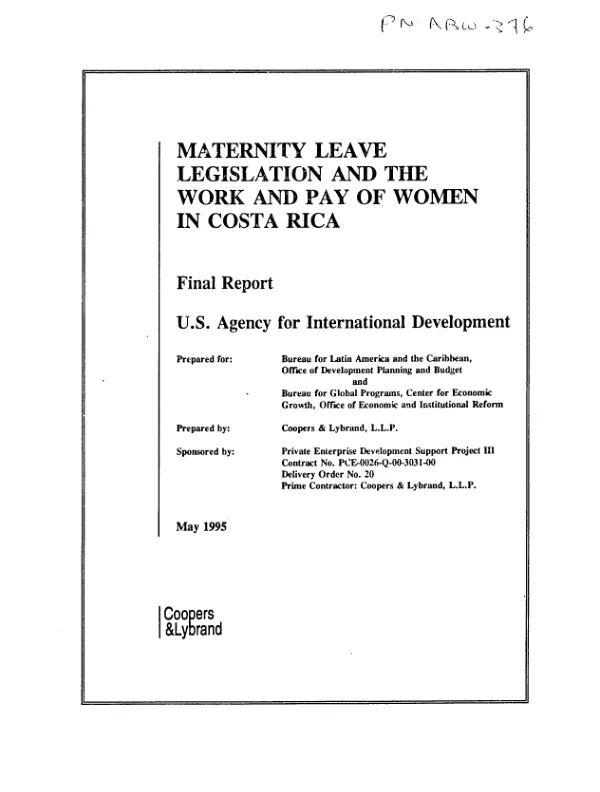
Maternity leave legislation and the work and pay of women in Costa Rica : final report
Sign inCOOPERS AND LYBRAND
Maternity leave legislation and the work and pay of women in Costa Rica : final report
A recent World Bank study in 15 Latin American and Caribbean countries identified a significant void in the literature on gender issues: the impact of labor legislation on women"s employment and pay.
Gindling, T. H.; Crummett, Maria · 1995
Sign in to readA free account is required to download.
Abstract
The present study examines the impact on wages and employment of three recent changes in the law governing mandated maternity leave in Costa Rica: (1) a 1980 increase of paid maternity leave in the public sector from 2 to 4 months; (2) a 1986 extension of this increase to the private sector, though with weaker enforcement mechanisms; and (3) a 1990 law significantly increasing enforcement of mandated maternity leave in the private sector. Chapter II provides an overview of maternity leave legislation in Costa Rica and discusses the three laws. Chapter III presents the empirical model used in the study to test the impact of these legislative changes on women"s wages and employment in three sectors of the economy (public, private, and self-employed), and the results of these tests. Chapter IV summarizes the study findings and presents policy implications. The study found that neither the 1980 nor the 1986 laws had any observable impact on the employment or wages of either men or women in any of the three sectors. However, following the 1990 law, women"s wages in the private sector fell; there were no other observable changes in employment or wages in any of the three sectors. These findings indicate that women fully value the benefit of maternity leave (i.e., treat the benefits the same as money wages), that legislative initiatives such as mandated maternity leave may be ineffective without enforcement mechanisms, and that mandated maternity leave legislation does not distort patterns of employment, and therefore has no impact on efficiency. Includes bibliography.
Related documents