MANAGEMENT SCIENCES FOR HEALTH
Matrice Rapport Trimestriel
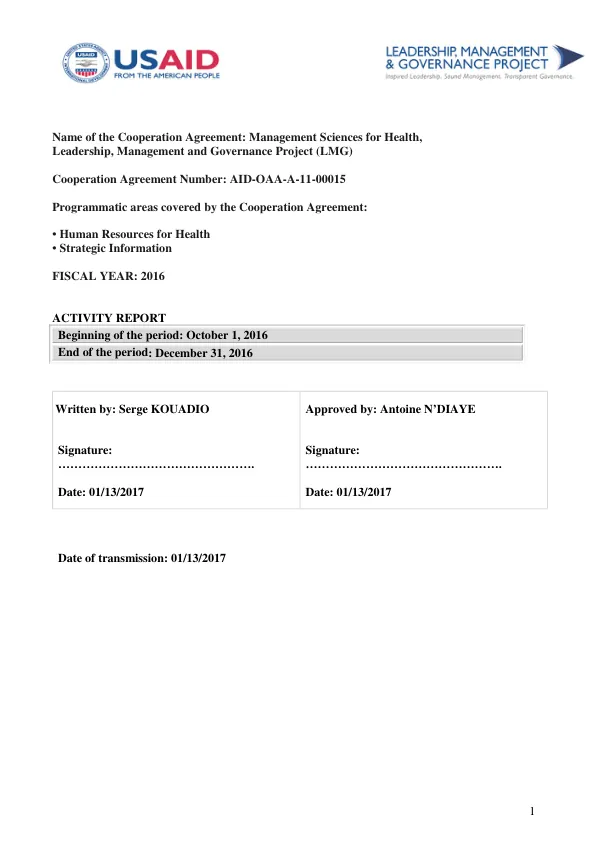
The Leadership, Management and Governance Project to Strengthen Coordination and Governance Capacity at Sub-national Levels for Ebola Preparedness in Côte d'Ivoire (LMG/CIEB) is a project funded by USAID/Côte d'Ivoire through FY 2015 Omnibus Ebola Emergency Appropriations.
2016 · 35 pages
Sign in to readA free account is required to download.
Abstract
The project aims to build sustainable, well-governed, and effective coordination structures for preparedness and response to Ebola and other infectious threats at the decentralized level. The project's specific objectives include increasing the capacity and performance of sub-national health directorates through improved leadership, management, and governance practices, improving governance, ownership, and coordination practices on sub-national levels, establishing routine cross-sectorial collaboration mechanisms among actors from human, animal, and environmental health, and integrating health emergency preparedness and response in broader, national strategies. The project provides support to the three health regions and corresponding health districts that border Liberia and Guinea in Western Côte d'Ivoire. During the reporting period of October-December 2016, the LMG/CIEB achieved several key milestones. Objective 1 focused on increasing the capacity and performance of sub-national health directorates through improved leadership, management, and governance practices. The project launched the Leadership Development Program (LDP+) process in the district-level referral hospitals in each of the three regions and provided equipment, furniture, and technical assistance to the Regional Health Directorates (DR) and Departmental Health Directorates (DD). The project also held a Training of Trainers (TOT) for the district level LDP+ process with 25 participants and a Stakeholder Alignment Meeting (SAM) in each of the 13 districts with a total of 331 participants. The SAM provided an opportunity for stakeholders to come together and align and mobilize around the LDP+ process in order to meet health challenges and achieve results for improved health systems in their districts. A total of 339 participants attended these meetings, with a significant representation from non-health sectors. Objective 2 focused on improving governance, ownership, and coordination practices on sub-national levels. The project held 41 out of 48 (85%) of planned monthly district health team and regional health team meetings, 6 out of 13 (46%) of planned regional and district quarterly coordination meetings, and 14 out of 18 (78%) of planned district and regional integrated supervision missions. The project also completed 19 out of 26 (73%) of planned data validation site visits in the three regions. Objective 3 focused on establishing routine cross-sectorial collaboration mechanisms among actors from human, animal, and environmental health. The project held 1 out of 3 (33%) of planned monthly regional Ebola committee meetings and 7 out of 39 (13%) of planned monthly meetings of the departmental committees for the fight against Ebola. Objective 4 focused on integrating health emergency preparedness and response in broader, national strategies. The project supported the three regions in implementing their integrated Ebola and infectious disease preparedness activities. The project's achievements during the reporting period demonstrate progress towards its objectives and contribute to the goal of building sustainable, well-governed, and effective coordination structures for preparedness and response to Ebola and other infectious threats at the decentralized level.