USAID DEC
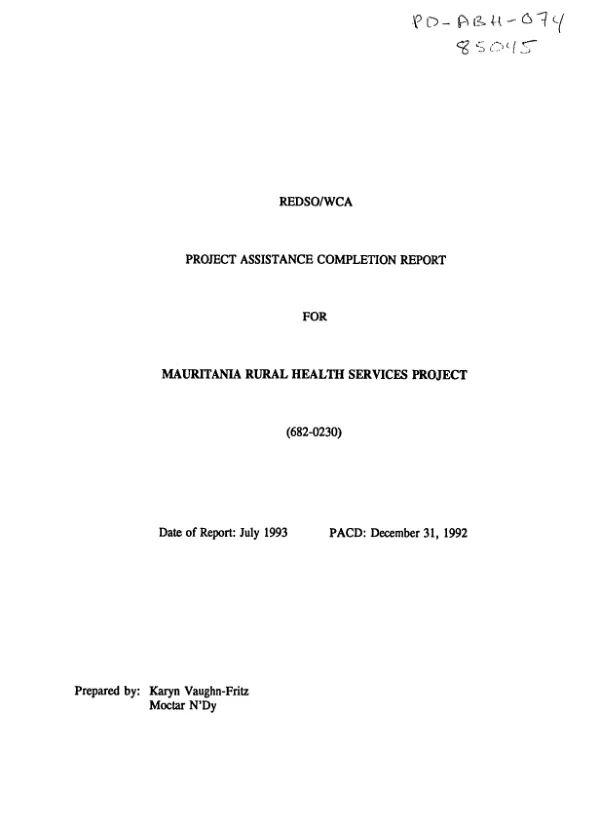
Mauritania rural health services project, contract no. 682-0230-C-4060-00 : final report
Sign inJOHN SNOW, INC. (JSI)
Mauritania rural health services project, contract no. 682-0230-C-4060-00 : final report
Final contractor report on a project to help Mauritania"s Ministry of Public Health and Social Affairs (MPHSA) improve its capacity to deliver rural primary health care services.
Foltz, Anne-Marie; Rich, Janet · 1989
Sign in to readA free account is required to download.
Abstract
The rport focuses on events following the mid-term evaluation in 7/86. The project assisted the MPHSA to set up a functioning EPI program with mobile teams and fixed facilities throughout the country. The cold chain functions, for the most part, and the EPI documentation unit is capable of producing annual reports. For the community health component, 273 village health workers have been trained and 258 have had refresher training. Training of health workers will soon begin for 68 recently sensitized villages. Three regional commissions on primary care plan for supervision and training within their own borders. Central, regional, and departmental supervisors/trainers have been trained. A data collection system geared to the competency of illiterate community workers has been designed to permit departmental and regional supervisors to monitor their work. Centrally, the project unit has successfully managed this regionalization and continues to provide training and supervisory support. MPHSA personnel from directors on down have benefited from training in management, epidemiology, computers, health information, training, supervision, and service delivery. As a result, there has been an evolution in the understanding of primary health care and an active discussion of it. Although the MPHSA has yet to show budgetary support to sustain the project"s community care component, it has demonstrated its commitment to primary health care by placing all primary care services within one administrative division. Most important, the capacity to training new community health workers in service delivery has been established. At the national level, the National Commission on Primary Care, formed in 12/88, is studying the potential for expansion of the program and expeimenting with ways to make it self-financing by applying selected recommendations of the Bamako Initiative. This activity is receiving strong support from UNICEF. In addition, some steps have been taken to integrate the various elements of the primary care system. (Author abstract, modified)