USAID DEC
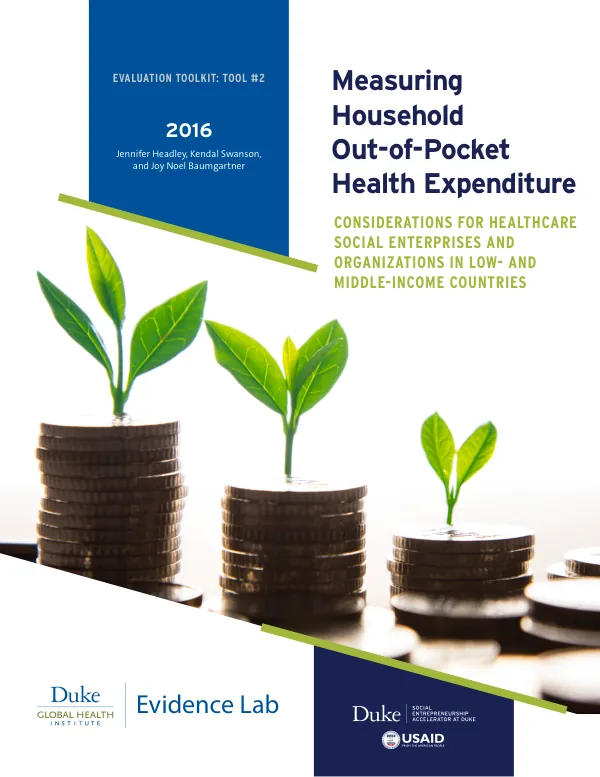
Measuring Household Out-of-Pocket Health Expenditure: Considerations for Health Social Enterprises in Low- and Middle-Income Countries
Sign inUSAID DEC
Measuring Household Out-of-Pocket Health Expenditure: Considerations for Health Social Enterprises in Low- and Middle-Income Countries
Household out-of-pocket health expenditure is a critical consideration for healthcare social enterprises and organizations in low- and middle-income countries.
2016 · 12 pages
Sign in to readA free account is required to download.
Abstract
Measuring this expenditure is essential to understand the financial burden on households and to evaluate the effectiveness of healthcare services. The average out-of-pocket expenditure per episode of illness at healthcare facilities in low- and middle-income countries is estimated to be a significant portion of total global health expenditure. Inefficient out-of-pocket spending on health is a major contributor to impoverishment around the world, highlighting the need for modern health financing mechanisms. Out-of-pocket health expenditure includes any direct outlay by households, including gratuities and in-kind payments, with the primary intent to contribute to the restoration or enhancement of health status. This definition can include transport costs and over-the-counter medicines or supplies, but does not include prepaid fees for health-related taxes or insurance. Data on out-of-pocket health expenditure is frequently measured at the household-level with either national surveys or research surveys. Many of these surveys are publicly available and provide examples of not only what questions are asked to capture out-of-pocket expenditure, but also demonstrate the survey structure and complementary questions, such as perceptions on quality of care. Healthcare social enterprises that typically promote themselves as delivering higher-quality services at a lower out-of-pocket cost need to measure consumer costs, substantiate their impact with credible evidence, and demonstrate how they contribute in a meaningful way toward global health priorities. Through measuring out-of-pocket health expenditure, particularly of the world's poor and near poor, discernable steps can be made toward improving health financing and protection. The World Health Organization defines financial catastrophe as direct out-of-pocket payments exceeding 40% of household income minus subsistence needs, while the World Bank defines it as out-of-pocket payments exceeding 10% of the household's total income. Lean data methods social enterprises can use to measure out-of-pocket health expenditure include defining and costing the parameters of a clinic visit or treatment of a condition, identifying strong comparison data, and deciding how to collect data from the comparison group. Inpatient and outpatient surveys can be used to collect data on out-of-pocket health expenditure, with typical recall periods ranging from 3 to 12 months. The Demographic Health Survey (DHS) OoP Health Expenditures Module provides a detailed list of survey questions and can be used to compare data to national or regional data. Local service providers can be used as a comparison group, with methods for collecting data including selecting a representative sample of clinics, visiting sample clinics to collect cost information, and outsourcing the process to an external firm. Mystery clients can also be used as a quality improvement or benchmarking exercise, incorporating in out-of-pocket costing metrics to obtain costs for comparable services.