NORC AT THE UNIVERSITY OF CHICAGO
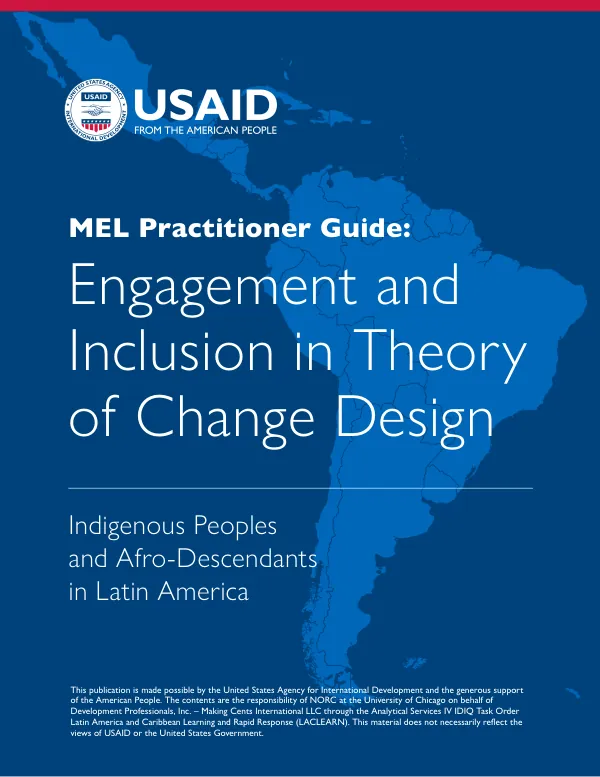
MEL Practioner Guide: Engagement and Inclusion in Theory of Change Design
The MEL Practitioner Guide: Engagement and Inclusion in Theory of Change Design is a resource for USAID personnel and implementing partners to ensure that Indigenous Peoples and Afro-descendants are engaged and included in theories of change (TOC) for democracy, human rights, and governance (DRG) activities in Latin America and the Caribbean.
24 pages
Sign in to readA free account is required to download.
Abstract
USAID's policies and strategies for engagement and inclusion have evolved over time, with key milestones including the 2014 publication of "Local Systems: A Framework for Supporting Sustained Development" and the 2020 Policy on Promoting the Rights of Indigenous Peoples (PRO-IP). The PRO-IP emphasizes the importance of engaging Indigenous Peoples and establishing partnerships with them to provide decision-making power and influence over development. The guide suggests that engagement with Indigenous Peoples and Afro-descendants in TOC design should begin during the contextual analysis phase of activity design and extend throughout TOC and indicator construction. This requires direct communication with these communities to elicit input and feedback and support joint decision-making. Planning for engagement involves several domains, including how to engage, whom to engage, and issues of accessibility and safety. The guide recommends considering the following questions when approaching engagement: * How to engage: Are Indigenous Peoples and Afro-descendants open to engaging with USAID? What are their traditional decision-making processes, and what cultural considerations might the team incorporate? * Whom to engage: What are the traditional authority structures/representative institutions in these communities? How can the team engage with subgroups/identities not represented by these structures? * Accessibility: What are the pros and cons of virtual engagement sessions versus in-person sessions? Are there electricity or internet issues for some groups, or geographically remote groups that would not be able to travel for in-person sessions? * Safety: How can the team ensure safe participation for Indigenous and Afro-descendant groups broadly, and more specifically for further marginalized subgroups? The guide also emphasizes the importance of considering the needs and experiences of Indigenous Peoples and Afro-descendants throughout the activity design and implementation process. This includes ensuring that formal free, prior, and informed consent (FPIC) takes place when a DRG activity could have significant adverse impacts on the rights, livelihoods, culture, lands, and territories of Indigenous Peoples. The TOC development team should consist of Mission/OU design staff, MEL staff, and inclusive development staff, as well as relevant staff from implementing partners. The team should plan for engagement and inclusion from the pre-award stage, with a focus on building relationships with Indigenous Peoples and Afro-descendants and incorporating their input and feedback into the TOC design. The guide provides a navigation structure for the MEL Practitioner Guide, including sections on planning for engagement, development challenge identification, contextual analysis, building out the TOC, indicators, next steps, and additional resources. The guide is intended to be illustrative rather than prescriptive, and can be adapted to fit the user's needs, time, and budget constraints, and current stage of activity design.