USAID DEC
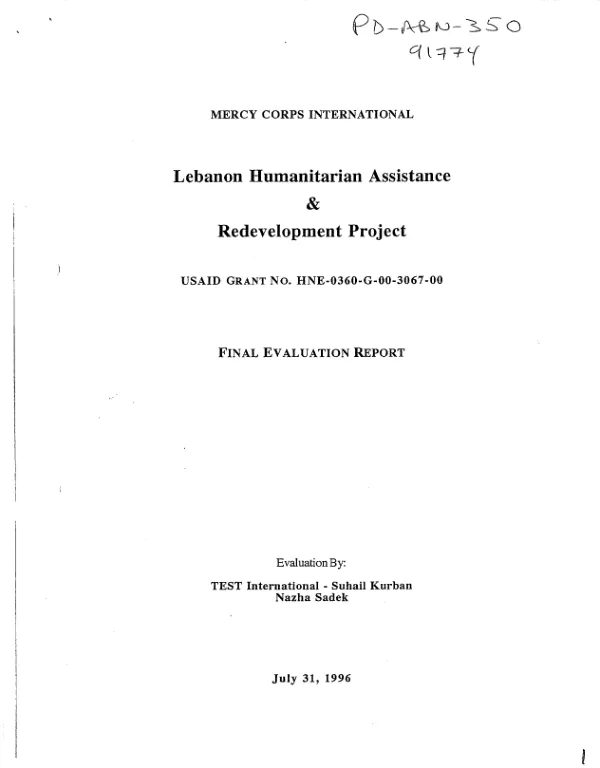
Mercy Corps International : Lebanon humanitarian assistance and redevelopment project -- USAID grant no. HNE-0360-G-00-3067-00 : final evaluation
Sign inTEST INTERNATIONAL
Mercy Corps International : Lebanon humanitarian assistance and redevelopment project -- USAID grant no. HNE-0360-G-00-3067-00 : final evaluation
Final evaluation of a project to implement reconstruction and redevelopment projects in the area East of Sidon and in Beirut, Lebanon.
Kurban, Suhail; Sadek, Nazha · 1996
Sign in to readA free account is required to download.
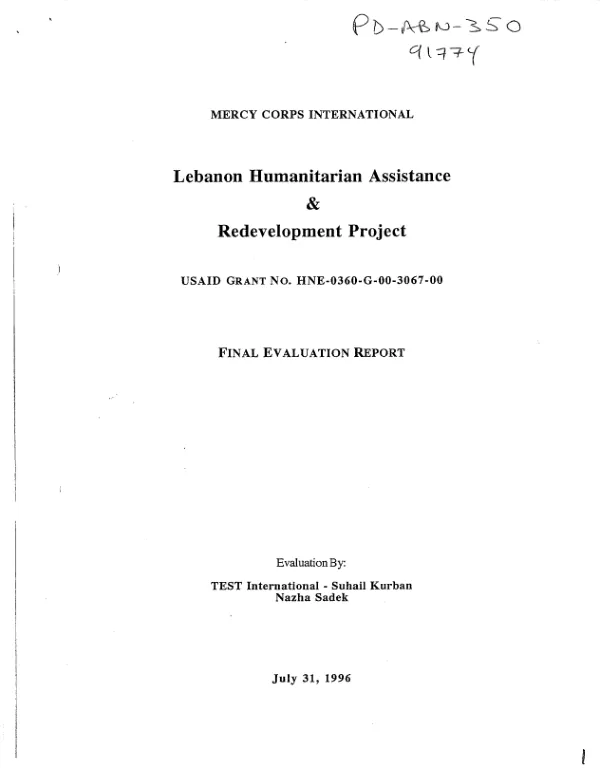
Abstract
The project was implemented by Mercy Corps International (MCI), in conjunction with the Middle East Council for Churches (MECC) and the Institute for Women"s Studies in the Arab World (IWSAW). The evaluation covers the period from 8/26/93 to 7/31/96, 1 month before the PACD. The project was a success, and targets were exceeded in all components. MECC awarded contracts to local construction companies which by the PACD will have repaired and rehabilitated 1,684 houses East of Sidon and in Aley and Souk el-Gharb, vs. a target of 1,230. These have enabled villagers to return home, although more assistance will be needed to create the basic conditions (such as employment, health care, schools, and community facilities) that will allow returnees to remain. The government has done less than what was expected to meet these needs. IWSAW developed an income-generation training program, supplemented by a Basic Living Skills program (BLSP), which has had a remarkable effect on trainees. A total of 404 women (vs. a target of 400) participated and gained confidence, decisiveness, and more positive attitudes about their futures; they are also teaching their neighbors and relatives what they have learned in BLSP. The vast majority have gained employment, where they are using their new skills. A total of 13 infrastructure micro-projects (vs. a target of 10) focusing on repair and rehabilitation of irrigation networks, agricultural roads, and terracing of land for cultivation have been completed in 10 villages in the East of Sidon, as well as in the Aley and Chouf areas. Nine more are to be completed by the PACD. These have allowed returnees to resettle and resume land cultivation in their villages. Community participation in the projects enhances their chances for sustainability. Over 130 representatives (more than double the target) of more than 40 indigenous PVOs participated in workshops to improve their skills in emergency and development situations, the planning of community development activities, priority-setting and strategy development, and internal management. The workshops were well-received by the NGOs, which expressed a desired need for additional training. In sum, the project was successful in encouraging displaced Lebanese to return to their homes by rehabilitating houses and some infrastructures, improving returnees" chances for employment, and in strengthening the capacities of some indigenous PVOs to continue community development efforts.
Related documents
Documents in this collection
 1996
1996USAID DEC
Mercy Corps International : Lebanon humanitarian assistance and redevelopment project -- USAID grant no. HNE-0360-G-00-3067-00 : final evaluation
Open record![Integrated rehabilitation and reconstruction program -- grant no. HNE-0360-G-[00]-5072-00 : annual and final report for the period 09/25/1995 to 09/30/1997](https://covers.devme.ai/gen/53303.webp) 1997
1997USAID DEC