USAID DEC
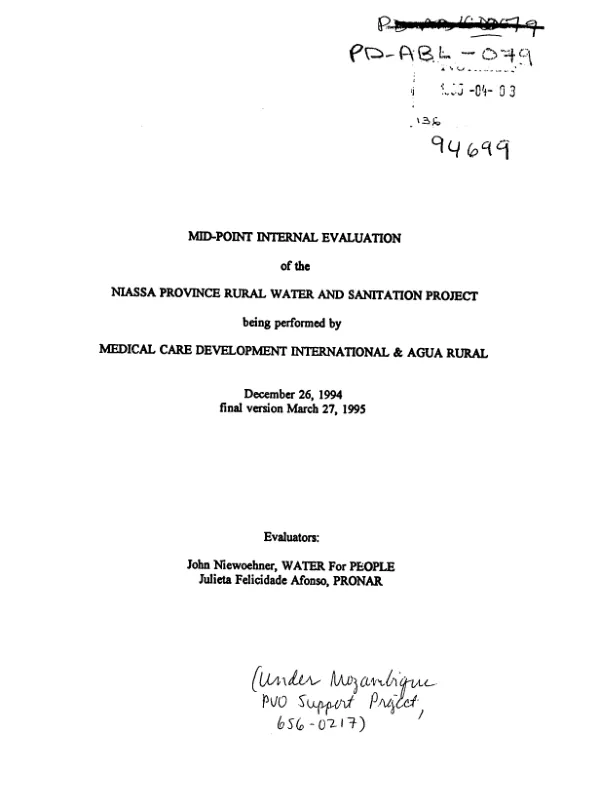
Mid-point internal evaluation of the Niassa Province rural water and sanitation project
Sign inAGUA RURAL
Mid-point internal evaluation of the Niassa Province rural water and sanitation project
Evaluates the Niassa Province Water and Sanitation Project for the period 9/93-12/94.
Niewoehner, John; Afonso, Julieta Felicidade · 1995
Sign in to readA free account is required to download.
Abstract
The project has been implemented by Medical Care Development International and Agua Rural. The objective of the two-year project is to construct 65 new hand-dug wells, rehabilitate 35 existing wells, promote latrine construction, and educate project beneficiaries in diarrhea prevention and well maintenance. The project"s central theme of sustainability is to be achieved by involving local people in the implementation of the project and strengthening Agua Rural. This concept of self-help is new to the local people who are accustomed to emergency assistance programs that provide services without requesting a local contribution to the project. The lack of sustainability of the emergency assistance programs is exemplified by a well project that took place in Cuamba between 1988 and 1990. Of the 35 wells installed by that project, only five are still operating. In the Niassa project, communities are approached by MCDI/Agua Rural animadoras (village extension workers) who help to mobilize the village in preparation for well and latrine construction. The Agua Rural technicians and masons then assist the villagers with construction. The villagers form water committees and contribute labor for well excavation and the collection of sand and rocks. The animadoras are also responsible for training village water committee members and providing health education in the importance of safe water and latrines, water storage and use, and hygiene. Between May and December 1994, thirty (30) new wells have been constructed, one existing well was rehabilitated, and two spring catchment tanks were constructed. Demonstration latrines were constructed in ten villages. In all of the villages water committees were established and local people donated their labor to the project. The wells were constructed in accordance with Mozambican government (Pronar) standards for well construction. The wells were dug to a depth of 2 meters below the static water table and the wells were lined with pre-formed concrete rings and stone masonry. On each well an Afridev pump was installed. All wells and spring catchments were located a sufficient distance from latrines or other potential sources of ground water contamination. The strength of the project is the strong team that has been formed by MCDI and Agua Rural/Cuamba. Frequent staff meetings assure that both Agua Rural and MCDI are involved in project organization and decision making. Thus far, the two major obstacles encountered by the project were the delay in getting the vehicles from customs and reluctance of some communities to provide in-kind contributions. The evaluators observed that there was a need to better define the pre- and post-construction health education program; to focus on the link between water, sanitation and diseases; and, to place more emphasis on a participatory training approach incorporating the results of the KAPB (Knowledge, Attitudes, Practices and Beliefs) study and better utilization of the health education materials available from PRONAR. The evaluation did note that the project had recently taken steps to improve the health education component through staffing changes that included the hiring of a Mozambican trainer as a counterpart to the new IEC supervisor. The evaluation also noted that several of the recommendations contained herein are already planned for implementation. (Author abstract)
Related documents
Documents in this collection
 1994
1994USAID DEC
CARE International in Mozambique -- community water and sanitation project -- Inhambane Province : mid term evaluation report -- final report
Open record 1994
1994USAID DEC