MANAGEMENT SYSTEMS INTERNATIONAL, INC. (MSI)
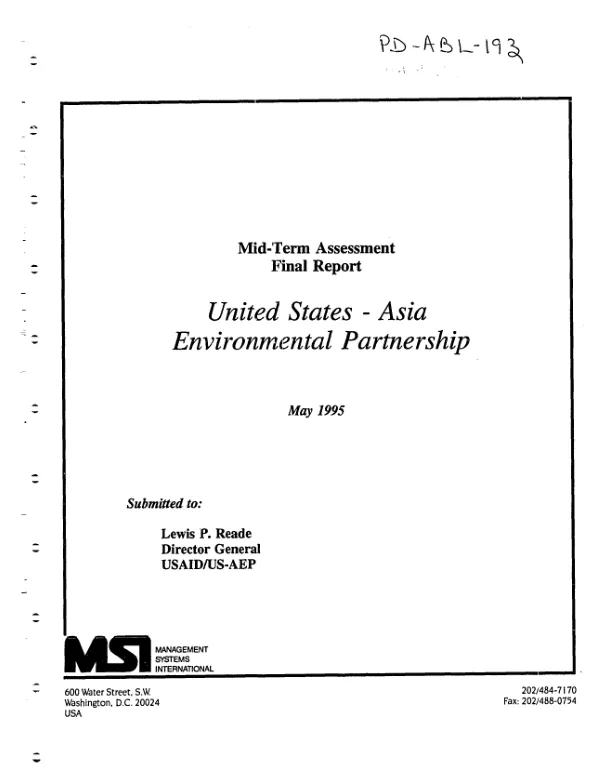
Mid-term assessment final report : United States - Asia Environmental Partnership
Evaluates project to foster U.S.-Asian partnerships that will improve Asia's environment through the transfer of environmental technology and management skills (US-AEP project).
1995
Sign in to readA free account is required to download.
Abstract
Midterm evaluation covers the period 1992-94. US-AEP, one of the largest projects in USAID's portfolio, has been highly successful, with nearly 1,000 activities completed as of 10/94, some 81% of them under the Professional and Organizational Development component (training, fellowships, and business exchanges). The project, which is becoming a well-known entity in Asia, currently directs the implementation of activities with some 16 public and private organizations. Recently, US-AEP introduced management adjustments which have increased its programmatic and cost-effectiveness. Specific achievements are as follows. (1) US-AEP has increased U.S. private sector involvement in Asia; the National State Development Agencies (NASDA) Technology Fund Program has recorded over $300 million in U.S. environmental technology sales to Asia, and the AETNA Trade Lead System has resulted in nearly $9 million in U.S. environmental technology sales. (2) Because of the wide variety of services it offers, the US-AEP project has become a useful adjunct to all of USAID's bilateral environmental strategies in Asia. (3) All of US-AEP's implementing organizations -- the Asia Foundation, the World Environment Center, the U.S. Environmental Training Institute, NASDA, the U.S. Environmental Protection Agency, and the Department of Commerce's U.S. and Foreign Commercial Service -- have received high marks from their Asian counterparts. (4) US-AEP's strongest "partnering" accomplishment has been its ability to broker institutional linkages between U.S. and Asian entities, particularly those in the private sector. US-AEP is sufficiently novel to conflict with key elements of USAID procedure. For example, USAID places emphasis on clear objectives and performance indicators, but US-AEP has not identified site-specific environmental objectives; this has caused tension between US-AEP and the Asia/Near East Bureau and raised doubts about whether or not the project is sufficiently focused. In any case, there is a widespread view, shared by the evaluation team, that US-AEP's image and impact would benefit from strategic clarification; the project should narrow its scope, without limiting its operational flexibility and entrepreneurial character. In addition, USAID must determine, given US-AEP's success, whether it should continue to be managed by USAID or by an interagency governance committee.
![Evaluation of the US-Asia environmental partnership [US-AEP]](https://covers.devme.ai/gen/5422.webp)
![Evaluation of the US-Asia environmental partnership [US-AEP]](https://covers.devme.ai/gen/44258.webp)
![Targeted grants program [Russian Far East] : final report](https://covers.devme.ai/gen/83568.webp)