USAID DEC
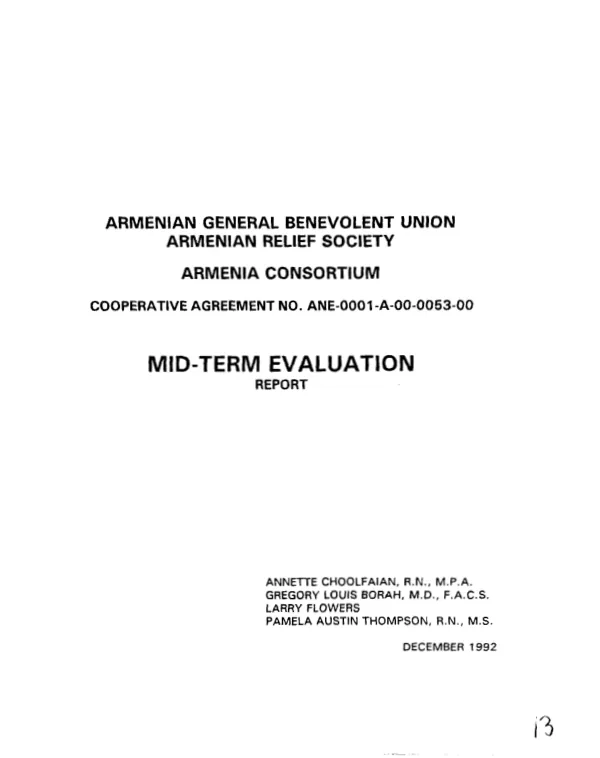
Mid-term evaluation : Armenia prosthetics/orthotics -- World Rehabilitation Fund : AID grant no. ANE-0001-A-00-0054-00
Sign inWORLD REHABILITATION FUND
Mid-term evaluation : Armenia prosthetics/orthotics -- World Rehabilitation Fund : AID grant no. ANE-0001-A-00-0054-00
Mid-term evaluation of a grant to the World Rehabilitation Fund (WRF) to train Armenian prosthetists to produce prosthetic equipment for victims of the 1988 earthquake.
Quigley, Michael|Chapnick, Bernie · 1992
Sign in to readA free account is required to download.
Abstract
The evaluation covers the period 9/90-11/92. WRF has been successful in training Armenian prosthetists to produce quality prosthetists, and five or six of those trained are considered technically competent to continue after the project's end. This is remarkable given the extreme difficulty which WRF has had in posting and retaining professional staff -- a difficulty which has seriously impeded training and left managerial gaps and a patchwork materials ordering system which has resulted in a shortage of some items, and a lifetime supply of others. The WRF facility produces about 200 limbs per year, the quality of the limbs is adequate by U.S. standards, and the staff appear dedicated and anxious to do a good job. Although the Ministry of Social Welfare (MSW) seems to accord the project a high priority, sustainability is in serious doubt because the facility operates at cost levels which cannot be met by the MSW. As the project heads towards conclusion, the first attempts are being made to utilize Russian-made components, which can be purchased with rubles, which are still used as the currency in Armenia. An attempt to charge nominal fees is still in the discussion stage; all limbs are now free. The WRF trainees are being paid a wage many times higher than the MSW standard (which is clearly insufficient to retain the staff); cost recovery is essential if they are to be paid more. The demand for prostheses greatly exceeds supply due to the increasing number of war victim amputees, both military and civilian; in fact, war victims greatly outnumber the earthquake victims originally targeted by the project. The number of amputees is estimated at 3,000, with waiting lists of several hundred at both the WRF facility and a small Soviet workshop which is still in operation. (The technology and equipment are antiquated at the Soviet workshop and the production methods slow and extremely labor-intensive, but the workshop -- unlike WRF's -- uses indigenous materials, and, moreover, it is sustainable by the MSW.)
Related documents
![Assessment report of Armenia/WRF [World Rehabilitation Fund] project for the war victim"s fund](https://covers.devme.ai/gen/75128.webp)