AMEX INTERNATIONAL, INC.
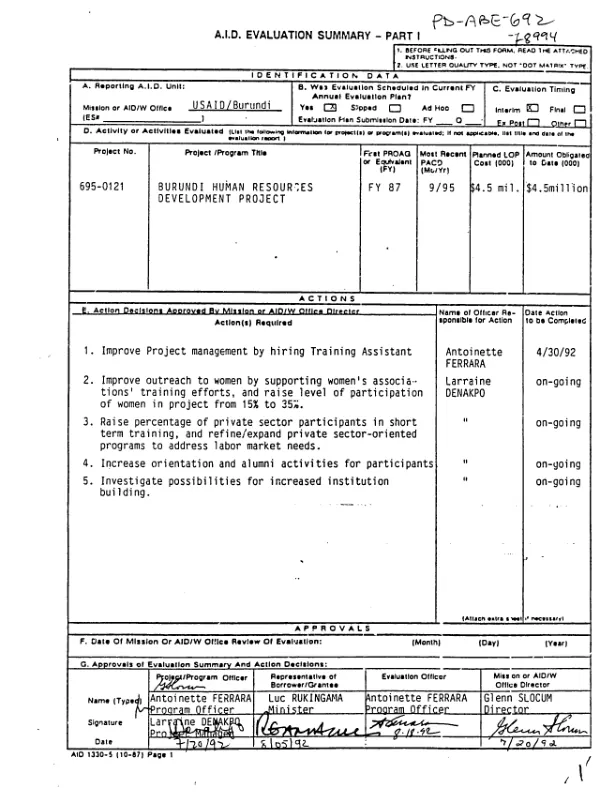
Mid-term evaluation : Burundi human resources development program (BUHRD, 695-0121)
Mid-term evaluation of a project to provide technical and managerial training to Burundians at the middle and senior levels in selected private and public institutions.
Gilboy, Andrew|Leroux, Dorothy · 1991
Sign in to readA free account is required to download.
Abstract
The evaluation covers the period 8/87-7/91. The project, whose purpose was revised in 1989 to focus more sharply on the private sector and the development of markets for farmers and small and medium enterprises, has been carefully and professionally managed and has achieved most of its targets. Long-term U.S. training starts are completed, with 19 candidates either returned, in training, or selected and ready to begin. Short-term U.S. and third-country training measured by completed programs and planned starts, has reach 103 of 105 planned. In- country training has reached 214 persons vs. 350 planned, and several additional large in-country programs have already been designed, contracted out, and funded. The project has also completed training in all thematic areas (agricultural/rural support, policy reform, business management, and market expansion) with the exception of rural-based microenterprise development, which is scheduled. Training has had some measurable impact on individuals, especially those from the private sector, who make up 37% of long-term trainees, 28% of short-term trainees, and 62% of in- country trainees. Moreover, nearly all civil servants sent for training have responsibilities in economic development and private sector promotion. The project has exceeded its 15% target for women's participation. Except for the Agricultural Research Institute of Burundi and the Chamber of Commerce, training has not had a significant impact on institutional development. English-language training has been cost-effective, innovative in design, and supportive of the project. Pre-departure orientation, however, has been less thorough than required, especially for U.S. short-term training. Although training in French was appropriate for certain audiences and themes, training in Kirundi for low-income women was also highly successful, suggesting that more programs of this type should be organized. A series of entrepreneurial development workshops and a training needs assessment were too costly and produced few results. Other in-country training programs were better tuned to Burundi's development needs.