INDONESIA. DIRECTORATE GENERAL OF COOPERATIVES
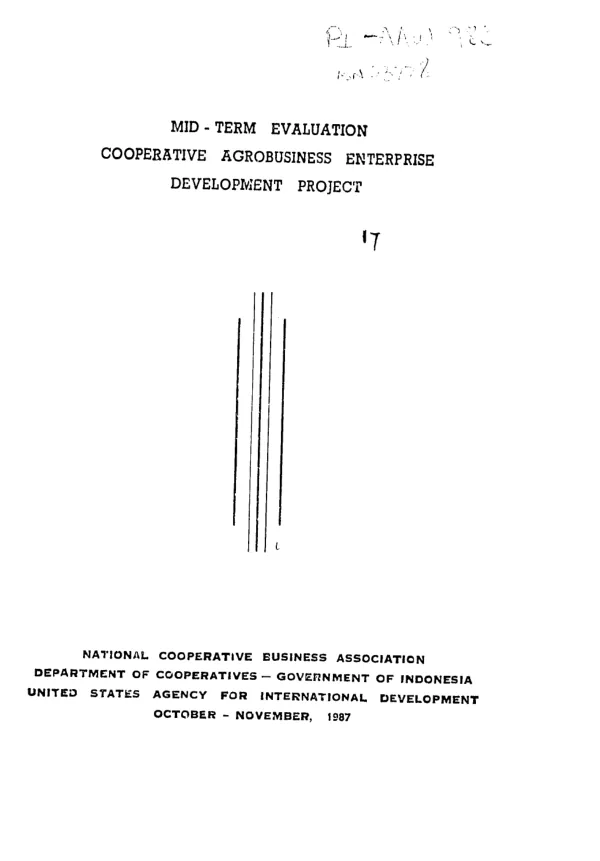
Mid-term evaluation : cooperative agrobusiness enterprise development project
Evaluates the Cooperative Agrobusiness Enterprise Development Project (CAEDP), funded with P.L.
1987
Sign in to readA free account is required to download.
Abstract
480 local currency, to strengthen Indonesian agribusiness co-ops at the district level. Mid-term evaluation covers 11/85-10/87 and is based on document review, site visits, and interviews with project personnel and co-op members. CAEDP is well-managed and making good progress toward objectives, although implementation has been hampered by a 30% shortfall in P.L. 480 Title II funding and by CAEDP's inability to date to obtain any of the promised Title I funds; moreover, the Government of Indonesia (GOI) has decided to provide only $2.3 million equivalent in Title I funds, not $6 million as originally planned. These funding shortfalls have delayed investment in infrastructure and reduced the amount of working capital available. CAEDP has also dropped, or is considering dropping, various planned activities, partly for financial reasons and partly due to delays and design changes in the planned A.I.D./IBRD Uplands Agricultural Conservation Project, in which CAEDP had planned to participate. In addition, changes in the economic environment (tied to a fall in oil export revenues) have altered GOI priorities and shifted project emphasis toward export-oriented, labor-intensive ventures and experiments with joint relationships with private firms. This has resulted in several unforeseen outputs, including a profitable furniture-making operation in Central Java employing 240 cabinet makers and wood carvers. CAEDP was also instrumental in arranging a joint venture between an Indonesian dairy firm and a large U.S. co-op (Land O' Lakes) for a nucleus estate which will import 20,000 dairy cows from the United States over the next few years, to be provided to small farmers, along with supporting inputs, as part of a credit package; CAEDP will provide feed and silage to the enterprise. CAEDP has identified several other potential enterprises: broiler and egg production, fish and shrimp production in brackish water, production and processing of vegetables and spices for export, and a rattan processing and furniture manufacturing joint venture. The only element of the project that can be broadly replicated in other situations is the establishment of a secondary co-op at the district rather than provincial level and providing it with managerial and financial autonomy to implement business operations outside normal government cooperative activities. The project also teaches that: private sector/cooperative working relationships can have benefits for each side; diversification from government-sponsored activities is necessary for long-term viability; substantial research is essential before large-scale implementation of new economic activities at the farmer level; and strict control over credit for member co-ops is essential to financial solvency.
Related documents