USAID DEC
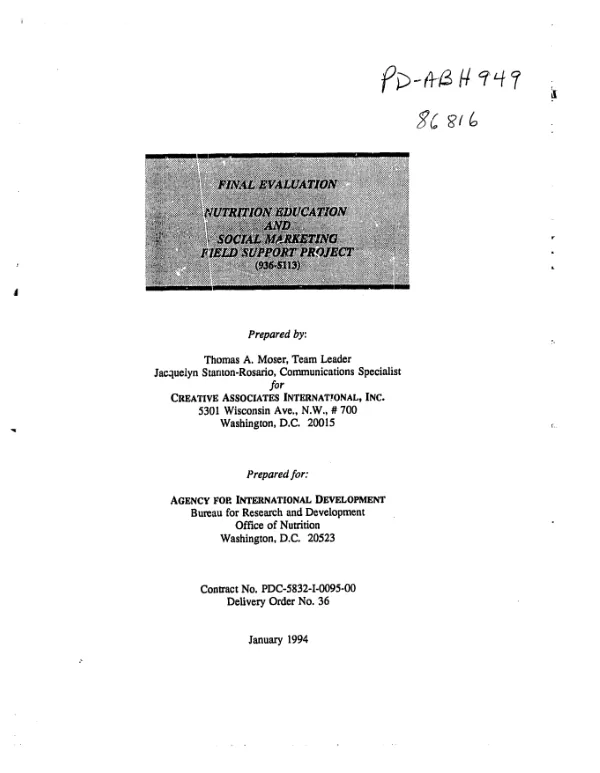
Mid-term evaluation : nutrition education and social marketing field support project
Sign inPRAGMA CORP.
Mid-term evaluation : nutrition education and social marketing field support project
Mid-term evaluation of a project to help Missions, host governments, PVO's, and other host country organizations to design, implement, and evaluate nutrition information, education, and communication (IEC) activities.
Moser, Thomas A.|Figueroa, Martha Weiss · 1990
Sign in to readA free account is required to download.
Abstract
External evaluation covers the period 9/87-11/90. There are few outcomes to assess at this time, since the project is only now becoming fully operational. Achievements have been as follows. (1) Specialists have completed several short-term field assignments, and their efforts have been well received. The project has also established a small, computerized reference library on communication and educational issues in nutrition. (2) Some 30 separate training events, mostly concerned with the social marketing of nutrition, have been conducted. The training appears suitable and intellectually stimulating. The problems that have arisen -- with recruiting the correct audience, balancing theory and practice, and trying to cover too much in a short time -- are endemic to most development training programs; they should be of continuing concern to S&T/N. (3) Only one resident advisor (RA) has been assigned (Honduras); the "up to six" mentioned in the Project Paper was unrealistic. Despite the lack of RA's, several country projects have been developed. Three are currently active (Mali, Burkina Faso, and Honduras), though it is still too early to draw firm conclusions. (4) Adequate baseline data are being collected to assess project impact at the consumer/beneficiary level; a process evaluation will need to be carried out to assess the value of training and TA at the institutional level. The Academy for Educational Development (AED), the primary implementing agency, is performing well in meeting contract objectives, but administration is fragmented, even in the countries where nutrition education activities are focused. This shortcoming is due in part to the buy-in process, which entails inordinate paperwork and confusion, a problem which may be alleviated through a new streamlined dual contracting mode, which involves one contract for core costs and another for buy-ins. At the same time, AED could better consolidate its efforts and focus them on fewer activities. AED should also make greater use of its subcontractors to complement its core staff. In the remaining year of the project, A&T/N should instruct AED to: (1) reassess country projects to ensure that they follow a coherent strategy for truly innovative, state-of-the-art activities; (2) develop state-of-the-art syntheses of lessons learned; (3) conduct, as part of existing country projects, one or more experimental pilot activities in a community-based mode; and (4) ensure sustainability by developing cadres capable of training others in nutrition communication interventions.