ATLANTIC RESOURCES CORP.
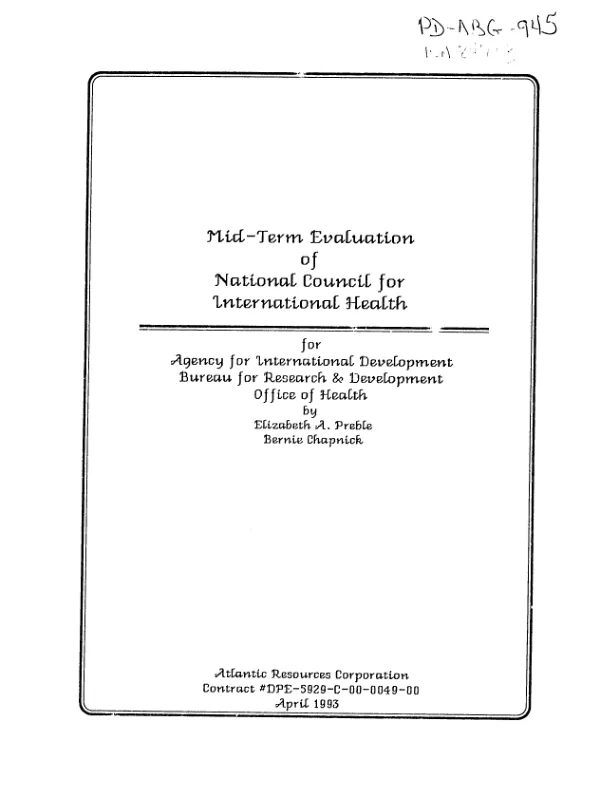
Mid-term evaluation of National Council for International Health
Evaluates a grant to the National Council for International Health (NCIH) to strengthen the role of PVOs in the prevention and control of HIV/AIDS.
Preble, Elizabeth; Chapnick, Bernie · 1993
Sign in to readA free account is required to download.
Abstract
Midterm evaluation covers the period 1991-1993. The project has been an effective and relatively inexpensive way for A.I.D. to help expand access to HIV prevention and control programs in developing countries. Under NCIH leadership, the PVO network expanded from 30 members in mid-1990 to over 140 by early 1993. Washington-based international health PVOs have benefitted most from the project, though the new relationship with Interaction may attract more non-health oriented members. While smaller PVOs have profited less, project leadership has made significant efforts to respond to their needs. It has been somewhat difficult for the project to involve indigenous PVOs because the level of funding has not been sufficient to reach small organizations based in developing countries. The project"s most impressive accomplishment has been the networking opportunities it has provided PVOs through: workshops, especially the annual conference, which remains NCIH"s premiere activity; newsletters, especially the bimonthly AIDSLINK; frequent informal meetings in Washington; and other links made by the Project Manager. These fora have given credibility and support to PVOs new to the area of AIDS/HIV, linked PVOs having common needs and valuable experience to share, matched PVOs with funding sources, and linked U.S. domestic and U.S. international PVOs. In addition to its service to PVOs, the project has become an information resource on the international AIDS epidemic for other organizations and concerned citizens. The project has also facilitated dialogue between PVOs and AIDSCAP, A.I.D."s largest AIDS project. In addition, the project manager has served as a de facto negotiator/facilitator in discussions of Government/PVO funding issues; an example is the Project"s role in preparing the draft concept paper, "HIV/AIDS flexible funding," in which PVOs present a rationale for increased funding of HIV/AIDs activities in developing countries. However, despite the utility of this role, it is strongly recommended that in the future the project concentrate on substantive, programmatic issues. While the project has improved PVOs" HIV/AIDS programming by facilitating the exchange of successful program models and experience, it has not played a major role in providing TA, information, or materials (the NCIH Project Manager feels that budget and staffing do not permit this), although it has frequently put PVOs in touch with sources of technical information. In the area of service delivery, efforts have focused on care for AIDS orphans through ongoing formal and informal meetings. The issue of home-based care may be discussed at a forthcoming workshop. Finally, the project has undertaken several initiatives not outlined in the original scope of work, including (1) planning a forthcoming meeting on AIDS in Eastern Europe with the Center for Strategic and International Studies (CSIS) and the International Center for Better Health; (2) participation in a CSIS working group on AIDS as a foreign policy issue; (3) assisting in the preparation of AIDS documents for President Clinton"s transition team; (4) working with Funders Concerned about AIDS to link domestic and international AIDS activities; and (5) contributing to strategic thinking on overall policy and program priorities for the U.S. Government in international AIDS efforts.