USAID DEC
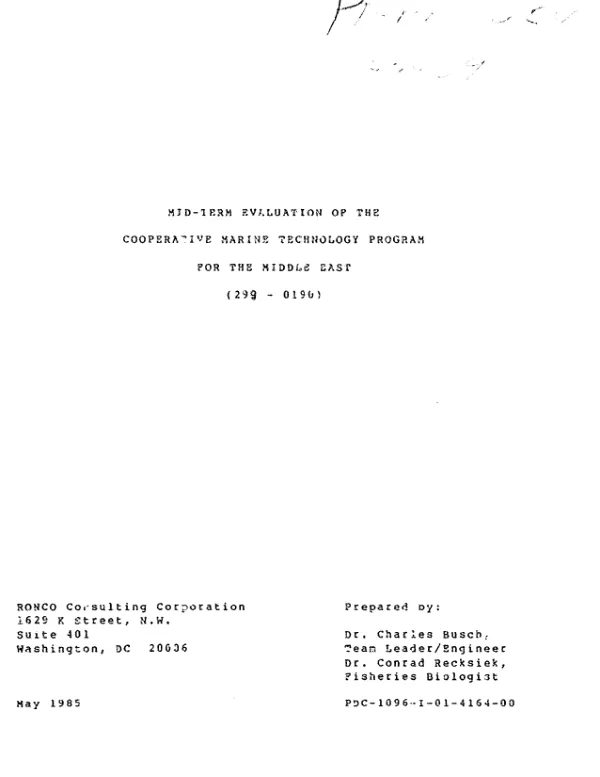
Mid-term evaluation of the cooperative marine technology program for the Middle East
Sign inRONCO CONSULTING CORP.
Mid-term evaluation of the cooperative marine technology program for the Middle East
Evaluates project to increase regional cooperation between Egypt and Israel in a joint marine technology program.
Busch, Charles|Recksiek, Conrad · 1985
Sign in to readA free account is required to download.
Abstract
Mid-term external evaluation covers the period 10/83-4/85 and is based on document review, site visits, and interviews with senior project personnel in Egypt and Israel. Progress has been steady; the scientific research is generally outstanding, and regional cooperation is good in view of the existing political climate. The program's annual meeting provides a friendly and open exchange of information with little concern for national affiliations. However, in some areas constraints still limit technical collaboration. More progress might have been made had other institutions, (e.g., the Egyptian Ministry of Agriculture), participated. Major problems are: (1) the reluctance of Egyptians to travel to Israel (Israeli scientists have traveled to Egypt twice in a group and two individual trips have also been made); (2) slow administrative procedures delaying fund disbursements; and (3) the absence of a unified logical framework. (A logframe developed by the evaluation team to replace the 11 original subproject (SP) logframes is appended.) Four SP's are underway. Under the Coastal Management and Shore Processes SP, both Egyptian and Israeli scientists cite the increasing reliability of the cassette acquisition system for collecting ocean wave energy data. As a result of the technology transfer effort begun during Phase I, valuable information is being accumulated on beach profiling, currents, and nearshore wave climate. Outputs of the Biological Productivity SP are above expectations: an "oceanographic baseline" for the southeastern Mediterranean; progress toward a "total picture" of primary productivity; and exposure of many participants, especially Egyptian students, to modern oceanography. The Monosex Tilapia SP is also performing well, with acquisition of basic data and more experience in breeding techniques. While the Fish Culture and Nutrition SP is, unfortunately, being phased out, substantial outputs have been generated. Successful and promising as the research is, the project has demonstrated that political differences can inhibit certain professional interactions. Additional cooperative work, now under consideration, should prove scientifically valuable and help to normalize Egyptian-Israeli relations.