GLOBAL EXCHANGE, INC.
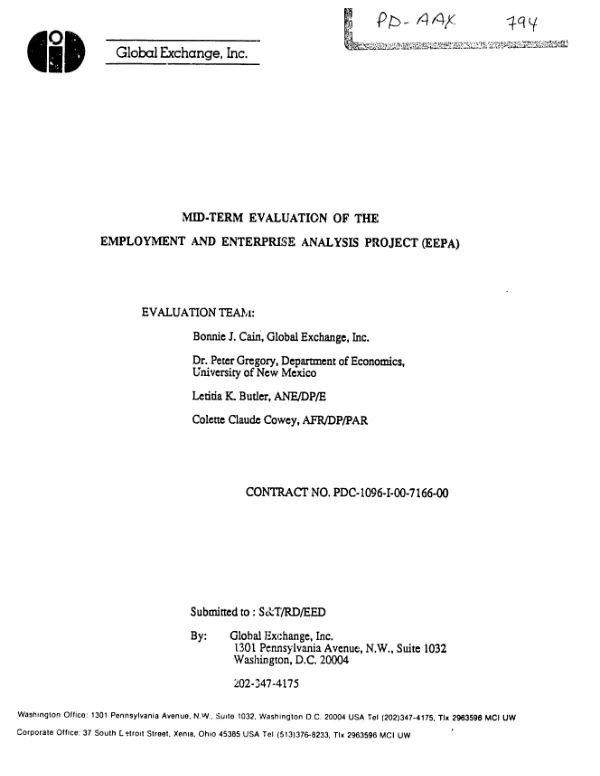
Mid-term evaluation of the employment and enterprise analysis project (EEPA)
Evaluates project to conduct research and policy analyses to support efforts to stimulate employment growth via small and medium enterprise (SME) development.
Cain, Bonnie J.; Gregory, Peter · 1970
Sign in to readA free account is required to download.
Abstract
Mid-term evaluation covers the period 9/84-1988. The major finding of the evaluation team is that the project has developed state-of-the-art research documents which question the initial project assumption that support of all SME"s will result in rapid employment growth in all countries. The following are the Evaluation Team"s conclusions. (1) State-of-the-art research has been conducted and published by the project. The research base and methodology developed by the project could enable USAID Missions to deal more effectively with employment generation as a policy issue. Dissemination of the findings needs to be improved. (2) Satisfactory long- and short-term TA activities have been conducted by the project. The project needs to consider coordination issues and procedures for developing a larger project memory of the findings of TA activities. (3) Sustainable policy change has resulted from several of the TA activities. Success appears to be tied to extensive involvement of Mission and host-country officials; successful processes for achieving this involvement should be recorded and institutionalized. Other findings follow. (1) The project should include more input from A.I.D. staff working in policy analysis and reform. (2) The project has not filed the required quarterly report for its long-term field projects. (3) The project needs to review the contract objective of institution/network building and determine if it continues to be essential to the success of the project. (4) The required annual workplans do not provide adequate detail to enable S&T/RD/EED to make administrative and budgetary decisions. (5) The project administrators must define what is being done by whom, for how much time at what rate. (6) The project contractors (Harvard Institute for International Development, Michigan State University, and Development Alternatives, Inc.) are geographically separated, a situation that requires a strong coordination plan. Quality control has not been consistent, nor have internal project communications allowed for peer review of documents. (7) Familiarity with the project among A.I.D. personnel is not optimal. Improvement in the presentation and dissemination of EEPA products is needed. Recommendations directly address the above issues. (Author abstract, modified)