USAID DEC
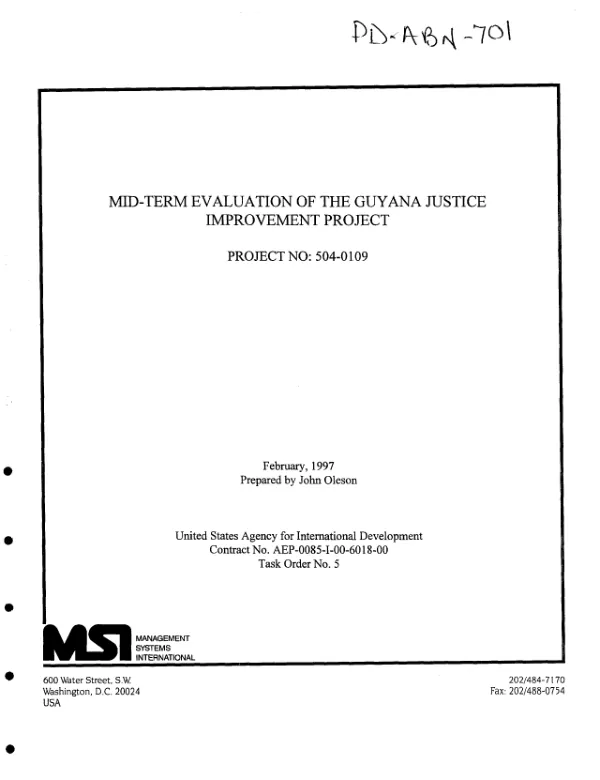
Mid-term evaluation of the Guyana justice improvement project -- project no. 504-0109
Sign inMANAGEMENT SYSTEMS INTERNATIONAL, INC. (MSI)
Mid-term evaluation of the Guyana justice improvement project -- project no. 504-0109
Evaluates project to improve the effectiveness and efficiency of the Guyanese justice system.
Oleson, John · 1997
Sign in to readA free account is required to download.
Abstract
Mid-term evaluation covers the period 9/94-12/96. The project is being implemented by the Ministry of Legal Affairs, the University of the West Indies (UWI), and the University of Guyana. There is a reasonable chance that many of the project's components can be substantially completed. Initial grants have been made to the Bar Association and the Georgetown Legal Aid Clinic. Eight Magistrate Courts outside of Georgetown have been completed, and work has begun on three others, on the Supreme Court's facility in New Amsterdam, and on the building for the High Court Library. Some materials for the Library have arrived and staff are being trained. Several workshops and lectures for judicial personnel and practicing lawyers have been held, and one person has completed the course in legal drafting at UWI. However, the largest targeted output -- improving the management of the court system -- will be difficult to achieve. Implementation has suffered from 3 main problems. (1) The Government of Guyana has not met its commitments to appoint a full-time, professional court manager or to provide the level of salaries and support required to attract and hold the personnel needed by the court system. (2) There have been serious delays in carrying out the various implementation steps, such as getting personnel in place and completing the planned analyses -- with much of the important work having taken place only in the last 6 months. (3) There are still gaps in the preparation for stage two of the project. An integrated program for working with the Registry of the High Court and a comprehensive training plan for the administrative personnel of the court system have not been completed; no work has been done in preparing for possible additional activities; and there is a need for significant programming work, including further revision of the project's budget and greater specification of the outputs and end of project conditions to be achieved. Confronting these problems has required more effort on the part of the USAID Project Manager than would be expected, and such effort is likely to be required in the future as well. Fortunately, that official is well-prepared and well-received. However, steps should be taken to strengthen UWI's implementation performance.