USAID DEC
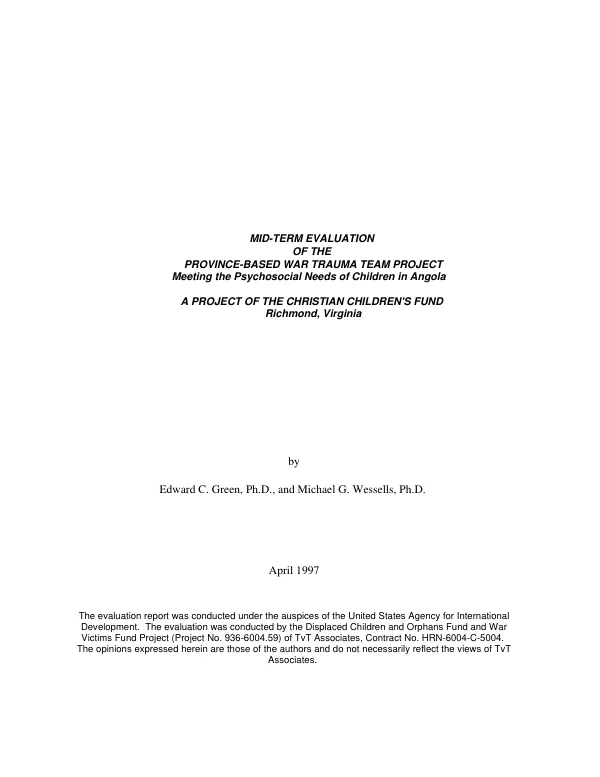
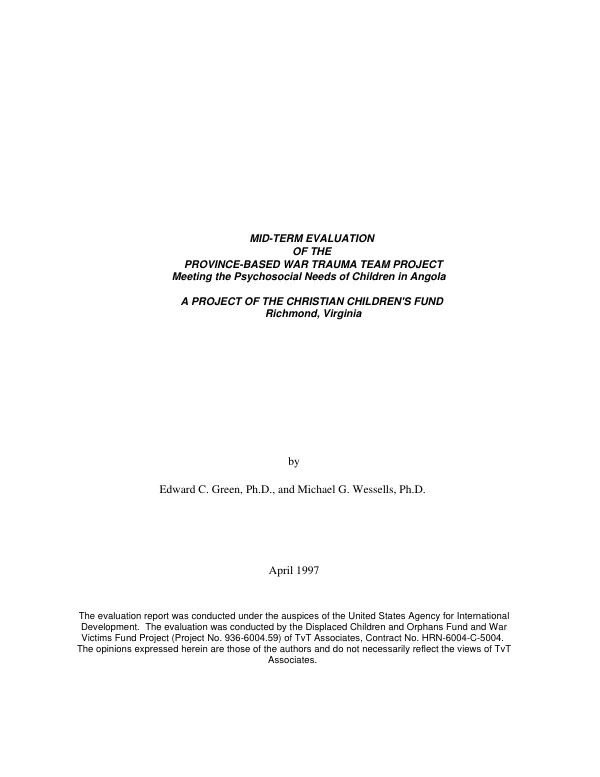
Mid-term evaluation of the province-based war trauma team project : meeting the psychosocial needs of children in Angola -- a project of the Christian Children's Fund, Richmond, Virginia
Sign inTVT ASSOCIATES
Mid-term evaluation of the province-based war trauma team project : meeting the psychosocial needs of children in Angola -- a project of the Christian Children's Fund, Richmond, Virginia
Evaluates Province-Based War Trauma Team (PBWTT) Project, implemented by the Christian Children's Fund (CCF) to train adults providing child care to meet the psychosocial needs of war-traumatized children in Angola.
Green, Edward C.|Wessells, Michael G. · 1997
Sign in to readA free account is required to download.
Abstract
Midterm evaluation covers the period 9/95-4/97. The project provides convincing evidence that a set of simple, low-cost, culturally appropriate and community-based interventions exists that can be taught to childcare-givers who can then help children who have suffered war-related stresses to measurably improve. At its midpoint, the PBWTT is well on the way toward achieving its training targets in a gender-balanced manner. The PBWTT has conducted 72 training seminars for 1,890 adults, half of them women. The trainees, selected through consultation with local influentials, include teachers, community volunteers (parents and community leaders), social workers, church volunteers or child welfare activists, administrators, health workers, and traditional political leaders. In all but one province, the PBWTT has effectively focused project resources on areas with the highest concentrations of war-affected children, as determined by situation analyses in each province. Adult trainees stated that the seminars had helped them to deal with their own trauma and war experiences, to understand that child behavior such as social isolation and aggression may be the result of war experiences, and to acquire specific tools and methods for intervening on behalf of children. The trainees noted the following improvements in children, including their own: improved child-child and child-adult relationships; improved school attendance and behavior and cooperation in the classroom; less aggressive behavior and less evidence of war-related games and toys; diminished isolation behavior; greater participation among children in institutions; fewer problems with concentration; and decreased hypervigilance and improved perspective and hope. Because the project addresses a significant need and gives adults a means of working personally on behalf of peace, the PBWTT has spread rapidly at the grassroots level. In addition, the prestige of the PBWTT skyrocketed through a joint effort with the Reintegration of Underage Soldiers (RUS), whereby the province-based teams of the PBWTT work with local catechistas (church volunteers) to demobilize and reintegrate underage soldiers; these tasks are widely regarded as critical for peace in Angola. Indeed, CCF/Angola has played the lead role among all organizations in the country because it has provided key technical and logistical assistance in the demobilization and reintegration of 40% of the underage soldiers who have been demobilized to date. Key problem areas include the magnitude of the workload on project staff, a lack of basic materials such as footballs, crayons, paper, and UNITA's resistance to CCF's promotion of pacifism, especially among the underage soldier population. (Author abstract, modified)
Related documents
Documents in this collection
 1997
1997USAID DEC
Mid-term evaluation of the province-based war trauma team project : meeting the psychosocial needs of children in Angola -- a project of the Christian Children"s Fund, Richmond, Virginia
Open record 1995
1995USAID DEC