USAID DEC
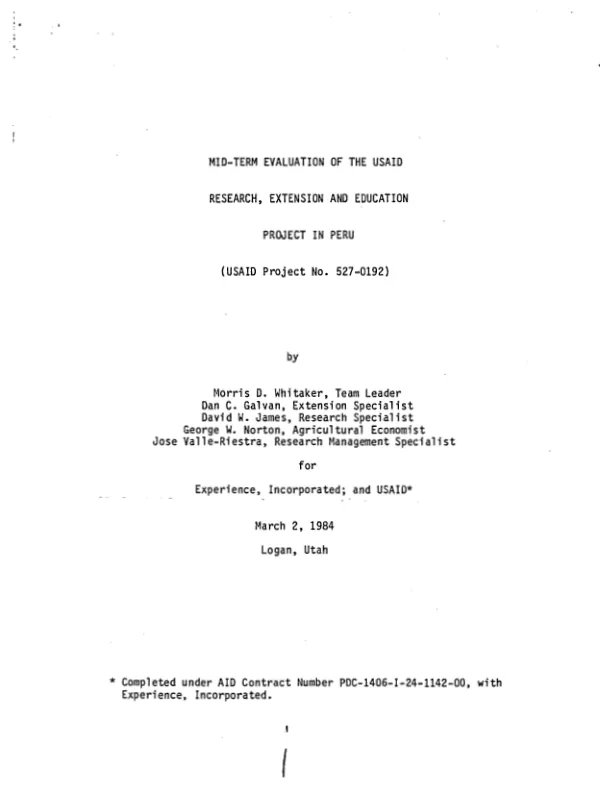
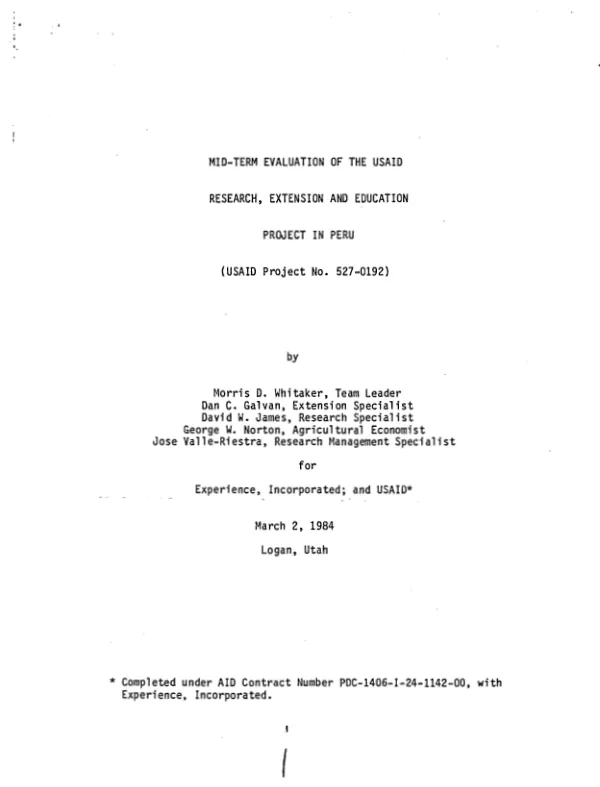
Mid-term evaluation of the USAID research, extension and education project in Peru (USAID project no. 527-0192)
Sign inEXPERIENCE, INC.
Mid-term evaluation of the USAID research, extension and education project in Peru (USAID project no. 527-0192)
Evaluates project to create an agricultural research, extension, and education (REE) system in Peru.
Whitaker, Morris D.; Galvan, Dan C. · 1984
Sign in to readA free account is required to download.
Abstract
Special evaluation covers the period 8/80-2/84 and is based on document review, site visits, and interviews with USAID/P, National Institute of Agricultural Research and Extension (INIPA), World Bank (IBRD), National Agrarian University (UNA), Interamerican Development Bank (BID), North Carolina State University (NCSU), and Government of Peru (GOP) personnel. Despite delays of over 2 years due to slow procurement of TA, GOP noncompliance with conditions precedent, and diversion of NCSU TA to help the newly-created INIPA combine A.I.D., BID, and IBRD projects into a nationwide Integral REE Program (IREEP), substantial progress has been made. Besides providing TA and the conceptual basis for the IREEP, the project has, inter alia: organized 18 Centers for Agricultural Research and Extension (CIPA"s), 5 Regional Research Centers (RRC"s), and 5 National Production Programs (NPP"s) - the latter are making especially good progress in developing improved corn, rice, and potato technologies and extending them to farmers; developed (ongoing) 5 regional and 3 central service laboratories (RSL"s) for crop extension/research and 3 new systems-focused National Programs; and formed project linkages with international agricultural research centers and collaborative research support programs. Long-term training is being provided to UNA/INIPA personnel, with 40 currently at UNA for M.S. degrees and 6 abroad for Ph.D. degrees; short-term training has also been provided. Several unplanned effects (some due to the creation of INIPA and IREEP) and weaknesses have hampered or altered the project, including: adoption of the ineffective training and visit extension system; integration of the NPP"s, RRC"s and RSL"s within CIPA"s; reduced emphasis on education and on UNA"s role; failure to implement the planned national research and management units (the latter adding to INIPA"s management difficulties); 1983 floods and drought; and inadequate GOP support. Key recommendations are to extend the project for 2 years and to begin planning for Phase II.
Related documents
![Final evaluation of the agriculture research, extension and education [REE] project : REE/AID no. 527-0192](https://covers.devme.ai/gen/72057.webp)
![Final evaluation of the agriculture research, extension and education [REE] project : REE/AID no. 527-0192](https://covers.devme.ai/gen/5176.webp)