USAID DEC
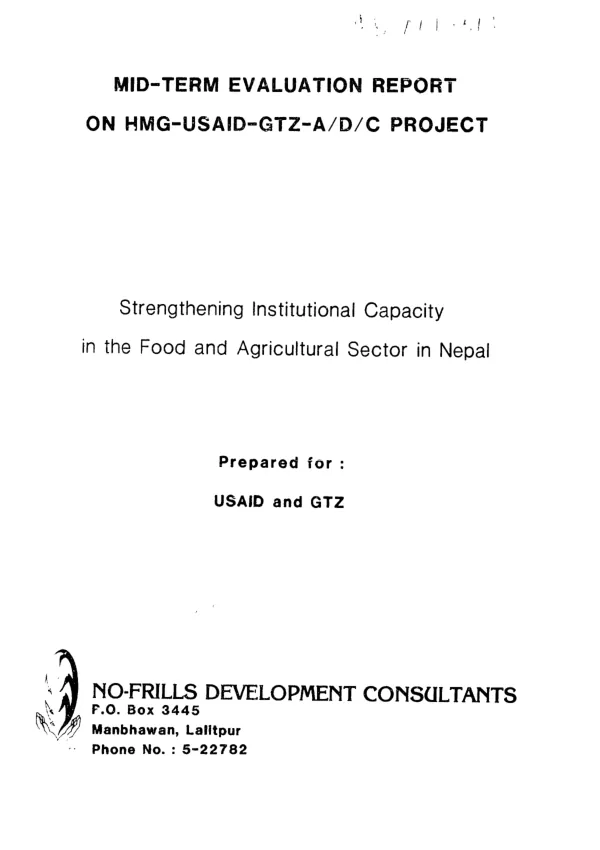
Mid-term evaluation report on HMG-USAID-GTZ-A/D/C project : strengthening institutional capacity in food and agricultural sector in Nepal
Sign inNO-FRILLS DEVELOPMENT CONSULTANTS
Mid-term evaluation report on HMG-USAID-GTZ-A/D/C project : strengthening institutional capacity in food and agricultural sector in Nepal
Evaluates project to help Nepal"s Agricultural Development Council (ADC) strengthen institutional capacity in the agricultural sector.
Toner, Joe; Scheffer-Biochorst, Wolf · 1985
Sign in to readA free account is required to download.
Abstract
Special evaluation covers the period 1982-3/85 and is based on interviews with ADC, Government of Nepal (GON), and USAID/N personnel. Although the ADC has made great strides in agricultural research and education, it is uncertain whether these gains will be translated into improved policy analysis and decisionmaking at the Ministry of Agriculture (MOA) and allied agencies. More than 40 research grants - several dealing with policy issues - have been made to individuals and agencies, and Ph.D. and M.S. training at institutions outside Nepal are proceeding very well; 20 fellowships (4 Ph.D., 16 M.S.) have been awarded during the current project. The training is rigorous and appropriate to Nepal"s special agricultural concerns, and the fellows have been of high calibre. However, excessive administrative duties have prevented returned fellows from using their skills on a daily basis, a problem which ADC is addressing by providing seminars, individual research grants, and support for professional activities. Other educational activities have included study tours and travel awards to observe programs in other Asian countries and 43 person-months of nondegree training. As for MOA institutional development, one crucial element seems to be lacking - a desire at the top levels to use research and analysis to develop and implement realistic agricultural policies. Progress in policy analysis has also been impeded by understaffing and frequent personnel turnovers within the MOA. Extension of the project should require evidence that the GON is genuinely committed to improving MOA management decisions and policy analysis. Recommendations include: strengthening organizations responsible for providing agricultural data; involving private sector and academic researchers; selecting fellows from more diverse geographic and academic areas, and especially from policymaking organizations; and providing management training for mid-career technical staff, additional professional training for returned fellows, and short-term policy research and analysis training for mid- and top-level MOA officials.
Related documents
Documents in this collection
 1985
1985USAID DEC
Mid-term evaluation report on HMG-USAID-GTZ-A/D/C project : strengthening institutional capacity in food and agricultural sector in Nepal
Open record 1969
1969USAID DEC