ACADEMY FOR EDUCATIONAL DEVELOPMENT, INC. (AED)
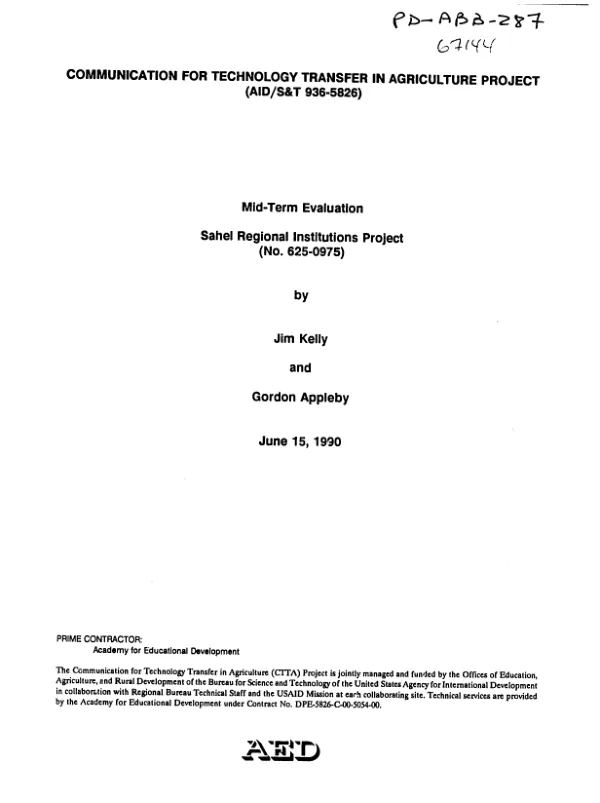
Mid-term evaluation : Sahel regional institutions project (no. 625-0975)
Evaluates two Secretariats responsible for promoting regional development in the Sahel -- the Permanent Interstate Committee for Drought Prevention in the Sahel (CILSS) and the Club du Sahel.
Kelly, Jim|Applegy, Gordon · 1990
Sign in to readA free account is required to download.
Abstract
The evaluation covers the period since CILSS' creation in 1973. Working together, the Secretariats expended enormous energy in the early years on drafting and updating a Sahel regional development strategy intended as a basis for preparing national development plans and aid policies. Over the years, however, there has been little evidence that Sahelian planners or donors have heeded the CILSS/Club "global view" of the Sahel's development needs. As a result, the Secretariats have moved away from regional strategizing to explore special themes or opportunities. For example, one focus in the 1980's was on generating productive dialogue on cereals-related policies. In general, however, CILSS and the Club have had limited success in translating regional discussion into national action planning. Direct lobbying at the national level has been difficult, and participants of CILSS/Club conferences have been ineffective in promoting the Secretariats' ideas in their home states. Moreover, much of what has been considered Sahelian-donor policy dialogue has actually been limited to debate among the donors themselves. CILSS and the Club have hosted several regional meetings to help donors better coordinate their development approaches. These sessions have been more successful in sensitizing donors to their differences than in melding program strategies or standardizing aid procedures. The quality of dialogue has improved with the help of the donor advisory group, formed in 1986. In the 1990's a key task of the Secretariats will be to use their abilities in information brokering to help Sahelians to discover and capitalize on emerging options. It is recommended that a Sahel Development Networking System be established which would focus on the Secretariats' two key areas -- food security and environmental management. The system would be developed not through large staff build-ups or budget outlays but by actualizing unused potential within the CILSS/Club system and strengthening existing linkages.
Related documents
![Sahel water data network and management III program (AGRHYMET project) : [Mid-term] evaluation](https://covers.devme.ai/gen/24748.webp)