USAID DEC
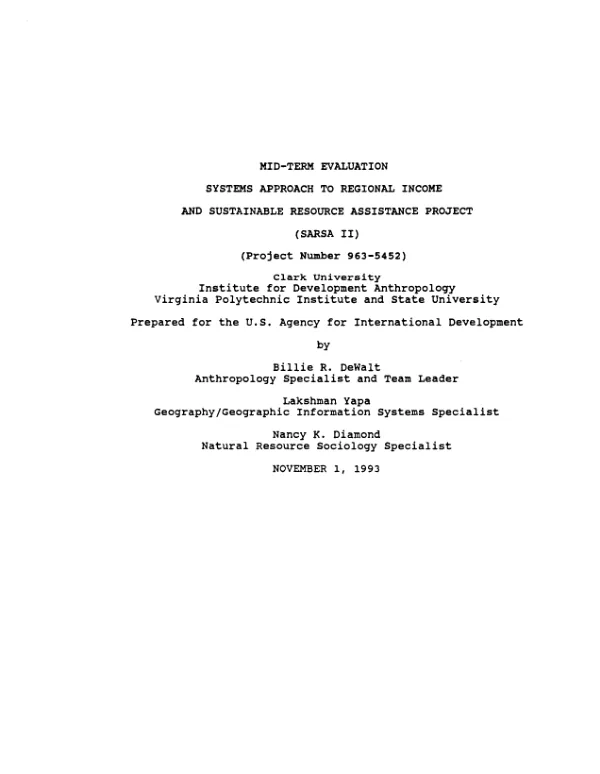
Mid-term evaluation : systems approach to regional income and sustainable resource assistance project (SARSA II)
Sign inCLARK UNIVERSITY
Mid-term evaluation : systems approach to regional income and sustainable resource assistance project (SARSA II)
Mid-term evaluation of a project (the SARSA II project) to support applied research on two interrelated themes: rural-urban linkages and natural resource management (NRM).
DeWalt, Billie R.; Yapa, Lakshman +1 more · 1993
Sign in to readA free account is required to download.
Abstract
The evaluation covers the period 1989-10/93. The project is being implemented by Clark University (CU), Virginia Polytechnic Institute (VPI), and the Institute for Development Anthropology (IDA). Overall, the project is producing high quality research that is useful and relevant to A.I.D./W and USAID Missions. A key indicator of this is that the project has generated more add-ons and OYB transfers than have similar cooperative agreements. However, there are many areas which require substantial improvement and/or change. Research highlights include, inter alia: (1) the strengthening of IDA"s applied anthropology capacity, which has produced many Mission add-ons and quality research -- in Tunisia on water management, in Senegal on the social and ecological effects of the Manantali Dam, in Burundi on household income strategies, and in Malawi on the estate sector; (2) IDA"s work in NRM, especially in Latin America and Africa, which is helping to refine an analytical framework elucidating how political, economic, and social factors at the micro- and macro-levels affect natural resource utilization and degradation; (3) the CU/VPI Ecology, Community Organization and Gender (ECOGEN) project, which is advancing concepts of feminist political ecology; and (4) CU"s work on refining the Participatory Rural Appraisal (PRA) method, as well as its development of a geographic information system software package, called IDRISI, which has been well received throughout the world. IDA has performed the best in developing its own capabilities, in implementing a coherent, relevant research program, and in meeting the needs of USAID and other donors. IDA has followed a clear trajectory in producing case studies that are then assembled, along with the work of other scholars, into synthesis documents. CU"s ability to productively interact with USAID missions and other donors is also well-developed. Through IDRISI, ECOGEN, and PRA, CU has carved itself out a useful niche, although the planned strengthening of its Department of Geography is proceeding far more slowly than expected. VPI is struggling; its failure to develop a coherent research program, or generate any interest in the form of add-ons from Missions, or to contribute in any of the ways originally envisioned has led to its increasing isolation from the rest of the project. More generally, the project as a whole lacks intellectual focus and direction, resulting in poor collaboration/coordination among CU, VPI, and IDA. For example, the integration of IDA"s anthropological and CU"s geographic perspectives has not materialized to the degree anticipated; and, with the exception of the CU/VPI ECOGEN effort, there has been no collaboration in gender-related research -- one of the project"s main planned outputs. Thus, while individuals at all three institutions seem genuinely committed to the values of sustainable development, project research appears to the work of solitary academics who are pursuing their own interests and agenda rather than collaborating to meet the needs of A.I.D. The project clearly needs better research direction to make its work more relevant and improved collaboration and integration between disciplines and institutions, and the evaluation makes recommendations to that effect. It also strongly recommends that dissemination of research results be improved; specific recommendations are to establish a standard format for all project reports which includes informative executive summaries, and to disseminate on a wide scale summary research reports from which readers can order full reports. Finally, funding for VPI should be limited to support of its ECOGEN researchers who have effectively collaborated with CU.