USAID DEC
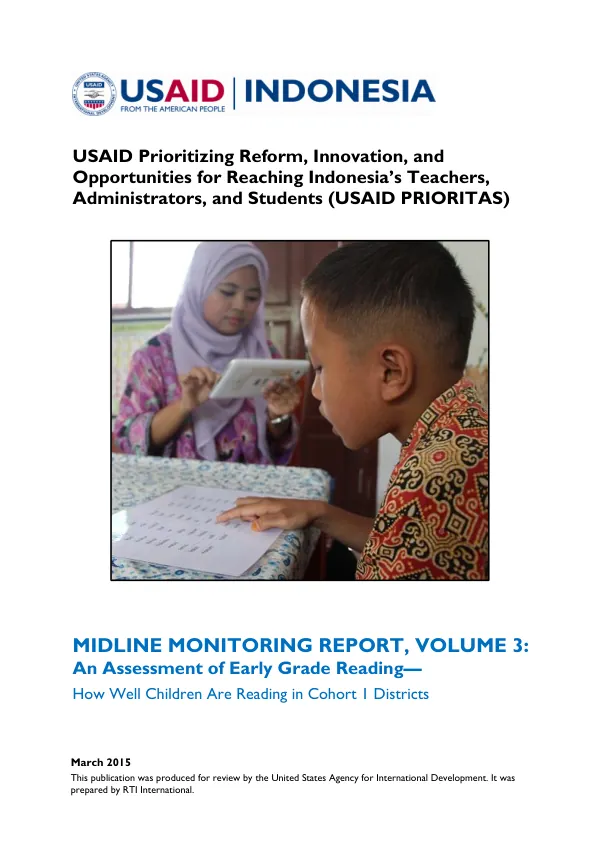
Midline Monitoring Report, Volume 3: An Assessment of Early Grade Reading—How Well Children Are Reading in Cohort 1 Districts
Sign inRTI INTERNATIONAL
Midline Monitoring Report, Volume 3: An Assessment of Early Grade Reading—How Well Children Are Reading in Cohort 1 Districts
The USAID Prioritizing Reform, Innovation, and Opportunities for Reaching Indonesia's Teachers, Administrators, and Students (USAID PRIORITAS) program aimed to improve reading skills among early grade students in Indonesia.
2015 · 92 pages
Sign in to readA free account is required to download.
Abstract
The program's midline monitoring report, Volume 3, assesses the reading abilities of children in Cohort 1 districts as of March 2015. The assessment used a revised early grade reading instrument and protocol, which was pilot-tested to ensure its effectiveness. The survey design involved a sample of students from various provinces, with data collection conducted through a combination of interviews and assessments. The study's limitations included the reliance on self-reported data and the potential for biases in the sampling process. The results showed that children in Cohort 1 districts demonstrated varying levels of reading proficiency, with overall summary scores indicating a need for improvement. Analysis by subtask revealed that students struggled with invented word reading, oral reading fluency, and reading comprehension. Regression analysis identified demographic indicators, such as province, gender, and location, as strongly associated with reading achievement. The report also analyzed reading performance across sampled schools, with overall summary scores indicating a need for improvement. Regression analysis for intervention-by-time effects revealed that certain interventions had a positive impact on student performance. Strong indicators of student performance included province, gender, location, language used at home, access to books at home, and pre-school education. The assessment also evaluated the teaching practices of early grade teachers, with findings indicating that they demonstrated good practice in teaching reading. Teachers regularly used early grade reading materials, and school managers initiated activities to create a school reading culture. These findings suggest that the USAID PRIORITAS program's efforts to improve reading skills among early grade students are showing positive results. The report's analysis by subtask revealed that teachers demonstrated good practice in teaching letter name knowledge, familiar word reading, and invented word reading. However, they struggled with oral reading fluency and reading comprehension. The report also identified areas for improvement, including the need for more effective teaching practices and increased access to reading materials. Overall, the midline monitoring report provides valuable insights into the reading abilities of children in Cohort 1 districts and the effectiveness of the USAID PRIORITAS program's interventions. The findings suggest that the program's efforts to improve reading skills among early grade students are showing positive results, but there is still room for improvement.