USAID DEC
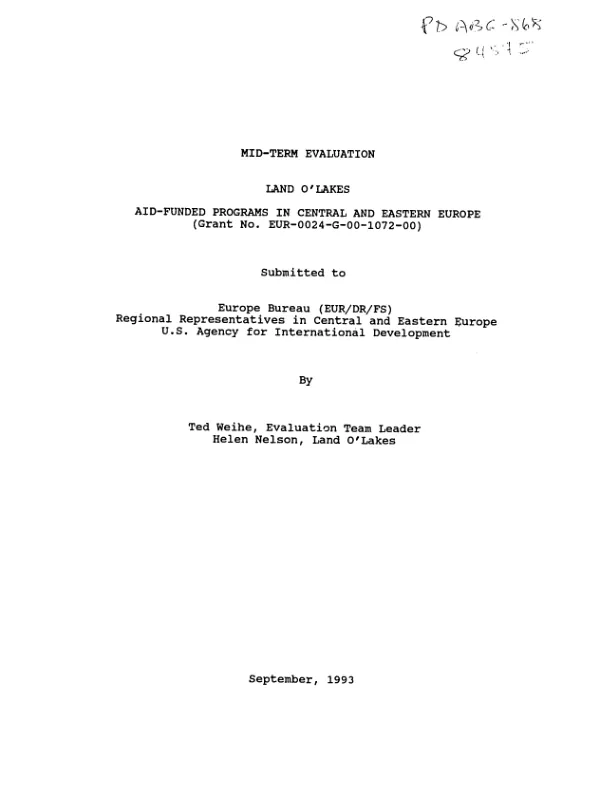
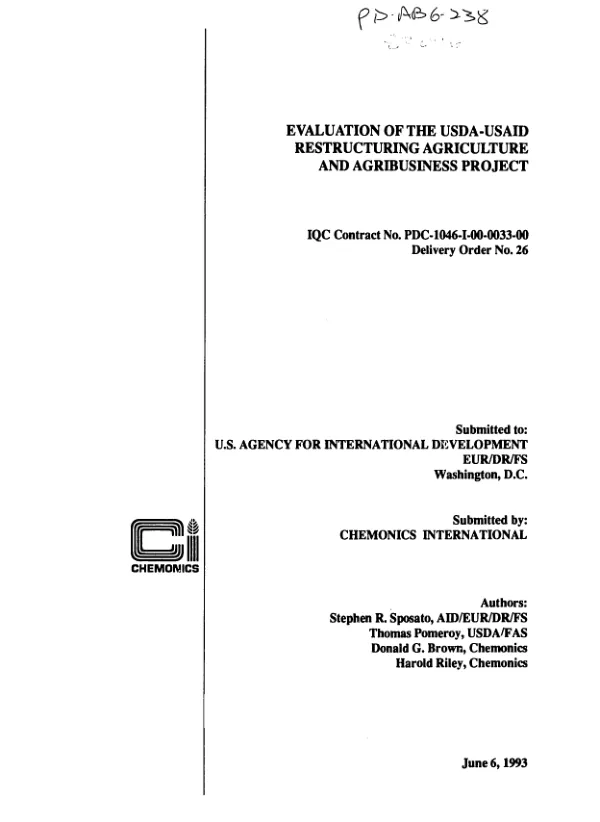
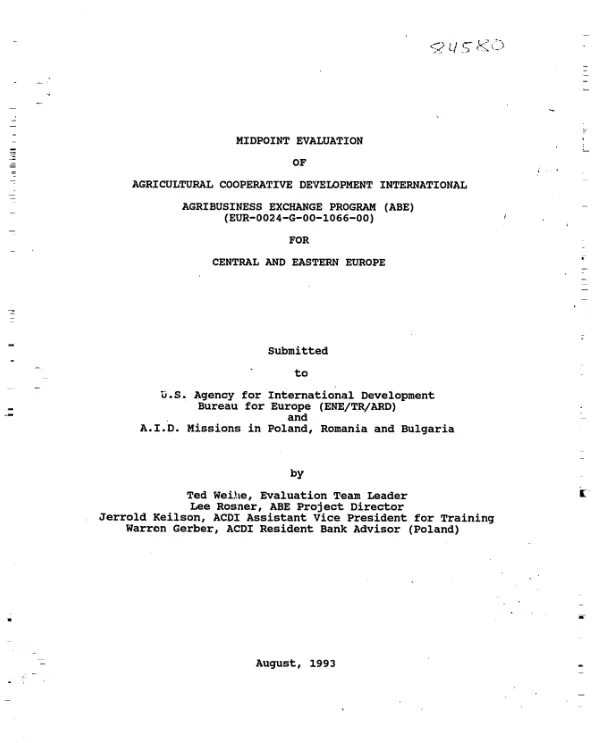
Midpoint evaluation of Agricultural Cooperative Development International, agribusiness exchange program (ABE) (EUR-0024-G-00-1066-00) for Central and Eastern Europe
Sign inAGRICULTURAL COOPERATIVE DEVELOPMENT INTERNATIONAL (ACDI)
Midpoint evaluation of Agricultural Cooperative Development International, agribusiness exchange program (ABE) (EUR-0024-G-00-1066-00) for Central and Eastern Europe
Mid-term evaluation of the Agribusiness Exchange Program (ABE) to increase the efficiency and effectiveness of private agriculture in Central and Eastern Europe through training.
Weihe, Ted; Rosner, Lee · 1993
Sign in to readA free account is required to download.
Abstract
Evaluation covers the period 4/91-8/93. The ABE training project is a good entry approach to assisting the development of private agriculture in Eastern Europe. U.S. training has been particularly effective in developing new patterns of free enterprise thinking and opening the minds of trainees to what is possible. Repeated in-country courses have created a strong cadre of private entrepreneurs, extension agents, rural bankers, and others committed to private sector cooperatives and farmer-controlled agribusinesses. The project has had the following outputs: (1) initiation of a national debate in Poland to prohibit cooperative employees from serving on boards of directors necessary to convert old style cooperatives to member control (legislation was subsequently vetoed by the president over this issue); (2) assistance in the drafting and passage of a new cooperative law in Lithuania, growing out of the shared experiences of U.S. training participants; (3) strengthening of small agribusiness companies and cooperatives, including an outstanding private poultry processing plant in Poland which uses U.S. packaging, processing, and other techniques; (4) training of extension agents, farm organizational leaders, and government officials, who constitute a strong institutional base to promote farmer-controlled agribusinesses, especially in Eastern Poland; (5) assistance in the creation of regional policies favorable to the formation of farmer-controlled cooperatives through strengthening of regional foundations; and (6) strengthening of 500 Polish rural cooperative banks and 3 recently formed regional banks by training key bank officials, managers, boards of directors, and over 285 loan officers, as well as rural lending institutions in Estonia and Romania, especially in credit lending practices for private agribusinesses. The project has an excellent evaluation system and is well coordinated with Volunteers for Overseas Cooperative Assistance (VOCA), USDA, and other providers of training and TA. Linkages with VOCA volunteers for short-term TA and to carry out U.S. training have been particularly successful. ABE will need to focus more tightly on a clear strategy and concentrate on change agents to enhance measurable impacts. ABE is ready to shift from generalized, diagnostic training to highly targeted training interventions at an enterprise level. The project is in the process of shifting resources to Southern Tier countries and has the opportunity to benefit from lessons learned from its earlier programs which have successfully linked small agribusinesses with sources of capital. Among the lessons learned are that training programs in Central and Eastern Europe are effective in helping the transition to a market economy through a "shift in thinking" by participants. However, demonstrated impacts require a series of training interventions, one-on-one TA and, in the case of entrepreneurs, access to finance. Generally, a training strategy should target emerging entrepreneurs in specific sectors of small-scale, value-added agricultural activities. Stand-alone training projects should be linked closely with other collaborators to provide a full range of interventions (e.g., policy and legislative reform, banking services and complementary short and long-term TA).
Related documents
Documents in this collection
 1993
1993USAID DEC
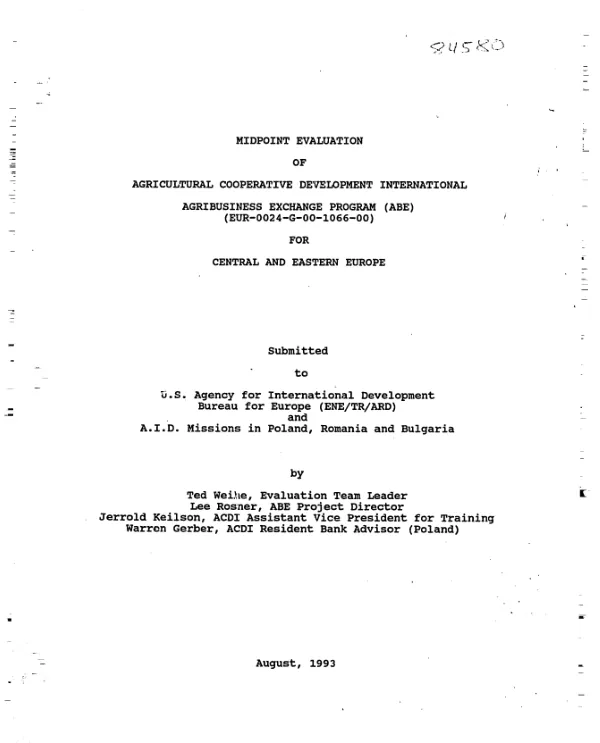
Midpoint evaluation of Agricultural Cooperative Development International, agribusiness exchange program (ABE) (EUR-0024-G-00-1066-00) for Central and Eastern Europe
Open record 1993
1993USAID DEC
![USAID/Lithuania Volunteers for Overseas Cooperative Assistance [VOCA] program impact report](https://covers.devme.ai/gen/5071.webp)