USAID DEC
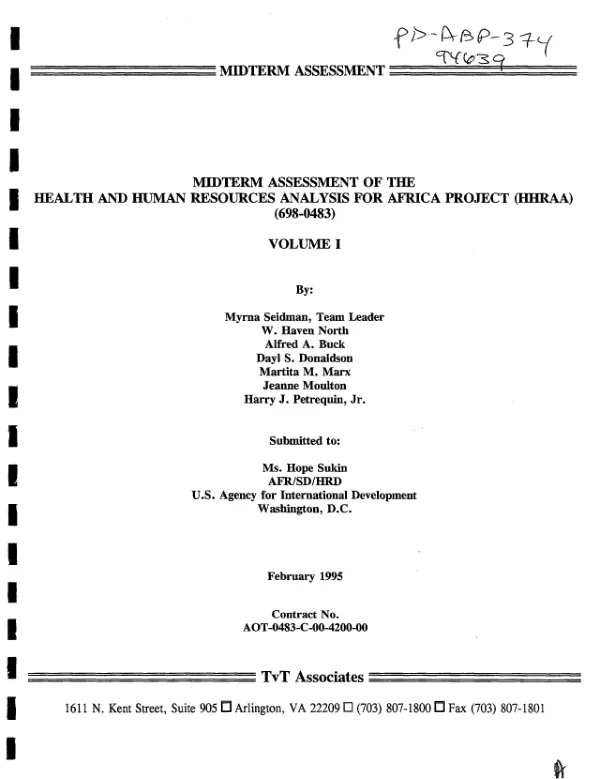
Midterm assessment of the health and human resources analysis for Africa project (HHRAA) (698-0483), volume I
Sign inTVT ASSOCIATES
Midterm assessment of the health and human resources analysis for Africa project (HHRAA) (698-0483), volume I
Evaluates project to increase the utilization of research and analyses for policy and program development and evaluation in the health and human resources sectors in Africa (HHRAA) project.
Seidman, Myrna|North, W. Haven · 1995
Sign in to readA free account is required to download.
Abstract
Mid-term evaluation covers the period 1992-2/95. The HHRAA project is unique in several respects -- it covers a broader range of human resource development areas than most USAID projects, supports a broad range of analytic activities from field research to information synthesis, stresses the use of research for program and policy action, and gives equal weight to research and information dissemination. In addition, HHRAA supports the participation of Africans and African institutions in all aspects of the project and seeks to ensure that its analytic activities are relevant to the people involved in health and human resource development in Africa. HHRAA also provides a broad umbrella for strategy development by the education and health and population subsectors. In the 2.5 years since its inception, HHRAA has grown from two full-time equivalent staff to a staff of 27 highly qualified professionals based in Washington and in offices in REDSO East and West. A highly flexible mechanism has been put in place for carrying out a diverse set of activities involving a variety of implementors in a number of sub-Saharan African countries. Results have been impressive. Ten strategic frameworks have been developed and over 100 research and analysis activities (vs. a target of 57) have been initiated. These activities are either already having impact or show the potential for such. For example, development of a child survival program design strategy helped change the Africa Bureau's child survival program and influenced program planning at both the regional and country levels; a review of immunization coverage in Africa led to a major joint USAID/UNICEF initiative focused on increasing the Expanded Program of Immunization (EPI) coverage levels; a global strategy for malaria control and treatment has been developed with WHO; an evaluation of the Botswana National Tuberculosis Program resulted in a number of program improvements; and direct assistance has been provided to revising USAID's basic education program in at least 8 countries. One of HHRAA's most important achievements has been to insert its activities into other donor programs and convince donors to undertake certain activities, including the Bamako malaria effort, the EPI program with WHO/AFRO and UNICEF, the Donors to African Education program, and the USAID's BASICS project, which has incorporated nutrition activities into its portfolio as a result of HHRAA's networking activities. Problem areas include the following. (1) While the project has succeeded in disseminating its results widely, this process has not been integrated into the activity design process and no research on the demand for such information has been performed. (2) The research and analysis (R&A) process is not guided by any overarching strategy for the health and population sub-sectors, and the existence of what appear to be too many ill-defined activities may fragment HHRAA's efforts and weaken its impact. (3) External reviews of research plans and protocols have only been made in the health financing subsector. Also, it has been difficult to determine the costs of research activities. (4) While Africans have participated in the project at every level, their contributions have been directed from Washington and USAID cooperating agencies so that they have had little opportunity to lead the analytic process. This may prevent them from assuming ownership of results. Similarly, except in the education subsector, Mission personnel have not been integrated into HHRAA activities. Many still feel more like observers than project participants. (5) The project has functioned without a full-time project officer or administrator, who is needed to bring coherency and direction to the project. (6) The decentralized nature of HHRAA operations, the number of implementing groups, dispersed staff locations, heavy work loads, and staff travel schedules have all contributed to a general lack of communication among the HHRAA staff. (7) HHRAA is not widely known and lacks a distinct identity; its niche within USAID and the Africa Bureau is not well-defined; its distinctive characteristics are not identified, developed, and promoted; and its relationships with other similar initiatives in health, population, and education are not clear. (8) Finally, a clear understanding of and agreement on end-of-project expectations is lacking.
![SARA [Support for Analysis & Research in Africa] work plan for 1999](https://covers.devme.ai/gen/56402.webp)