TVT ASSOCIATES
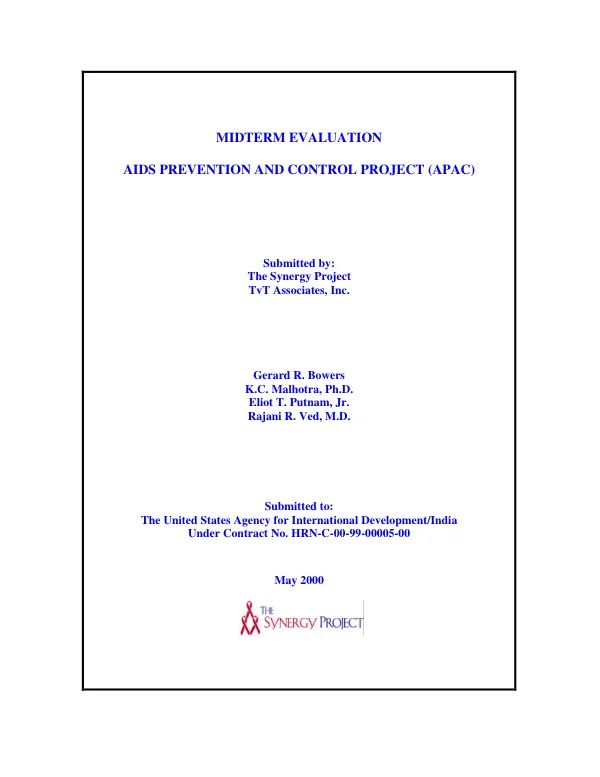
Midterm evaluation : AIDS prevention and control project (APAC)
Evaluates the AIDS Prevention and Control (APAC) project, aimed at preventing the spread of HIV/AIDS by core transmitters (commercial sex workers and their clients, truck drivers and other transportation workers, slum dwellers, and sexually transmitted disease [STD] patients) in the Indian State of Tamil Nadu.
Bowers, Gerard R.|Malhotra, K. C. · 2000
Sign in to readA free account is required to download.
Abstract
Interim evaluation covers the period 1992-5/00. The project is being implemented by Indian NGOs (mostly urban) in partnership with state entities. The project is meeting its objectives and has already achieved most of the benchmarks identified in the USAID agreement. Examination of data from three waves (1996 97 98) of the HIV-Risk Behavioral Surveillance Survey (BSS) in Tamil Nadu and from NGO monthly reports indicate that meaningful behavior change is underway in the state, much of it directly attributable to APAC. Key behavior changes among target groups include an increase in condom use, an increase in STD treatment-seeking behavior, and decreases in sexual contacts with non-regular partners. Commercial sales of condoms in Tamil Nadu have more than doubled, from 12.6 million pieces in 1995 to 27.9 million pieces in 1999. However, sales plateaued to a modest 4% increase during the 1998 99 period, due to a waning of the project's cooperative effort with an Indian firm to market condoms through additional, nontraditional outlets, weaknesses in condom promotion for NGO staff and marketing training for potential retailers, and the plentiful supply of free condoms in Tamil Nadu. APAC activities to date have been very effective in making the topic of condoms less sensitive in Tamil Nadu and in introducing the notion of condom use into the popular vocabulary. APAC has developed a comprehensive STD care strategy that focuses on raising demand for STD care and on training a large pool of providers in quality STD case management to meet the increased demand. Increasing numbers of patients are being referred for STD care and are receiving treatment from medical practitioners associated with and/or trained by the project. APAC supported NGOs have established strong referral networks with public and private sector treatment facilities. Some elements of the training and follow-up strategy need refinement; APAC has to ensure that operations research efforts focus on research matters and are not managed as intervention projects. APAC provides a comprehensive package of technical, organizational, and evaluative support for participating NGOs. The management and staff of virtually every NGO contacted by the evaluation team pointed to this intensive, nurturing relationship with APAC as singularly important to improving its competence in HIV prevention and its overall effectiveness as a community-based service organization. Management of the APAC project is sound and minimizes unsustainable expenses. The key to its success is its excellent and committed staff, assembled through a rigorous and open recruitment process. The partnership between Voluntary Health Services (VHS) and the Tamil Nadu State AIDS Control Society (TNSACS) has been mutually supportive, emphasizing complementarity of roles within the overall context of the state STD/HIV/AIDS agenda. On a national level, the National AIDS Control Organization (NACO) acknowledges APAC's importance and has used the APAC model as a reference point for targeted interventions in India, though its failure to facilitate an uninterrupted flow of funds to the project has been a source of deep concern. Finally, APAC's partnership with USAID/India has been one of the project's strengths. The Mission negotiated vigorously with the Government of India over key elements of the APAC agreement and invested much time and energy in helping the project develop its systems and launch its activities, a process generally acknowledged (especially by APAC) to have been critical to its successes. USAID will have to maintain this activist posture vis-a-vis NACO if it is to develop a durable solution to the project's financial problems. APAC is positioned to extend its success to other parts of Tamil Nadu, to reach out to groups not covered by the current activity (e.g., industrial workers), to add services (e.g., community-based care) not currently included in the project, and to improve its diagnosis and treatment capacity through an STD reference laboratory. The project should be extended to March 2005, at increased funding, to create the means for these new elements. (Author abstract, modified)